
Lost My Wallet — Here's Exactly What to Do
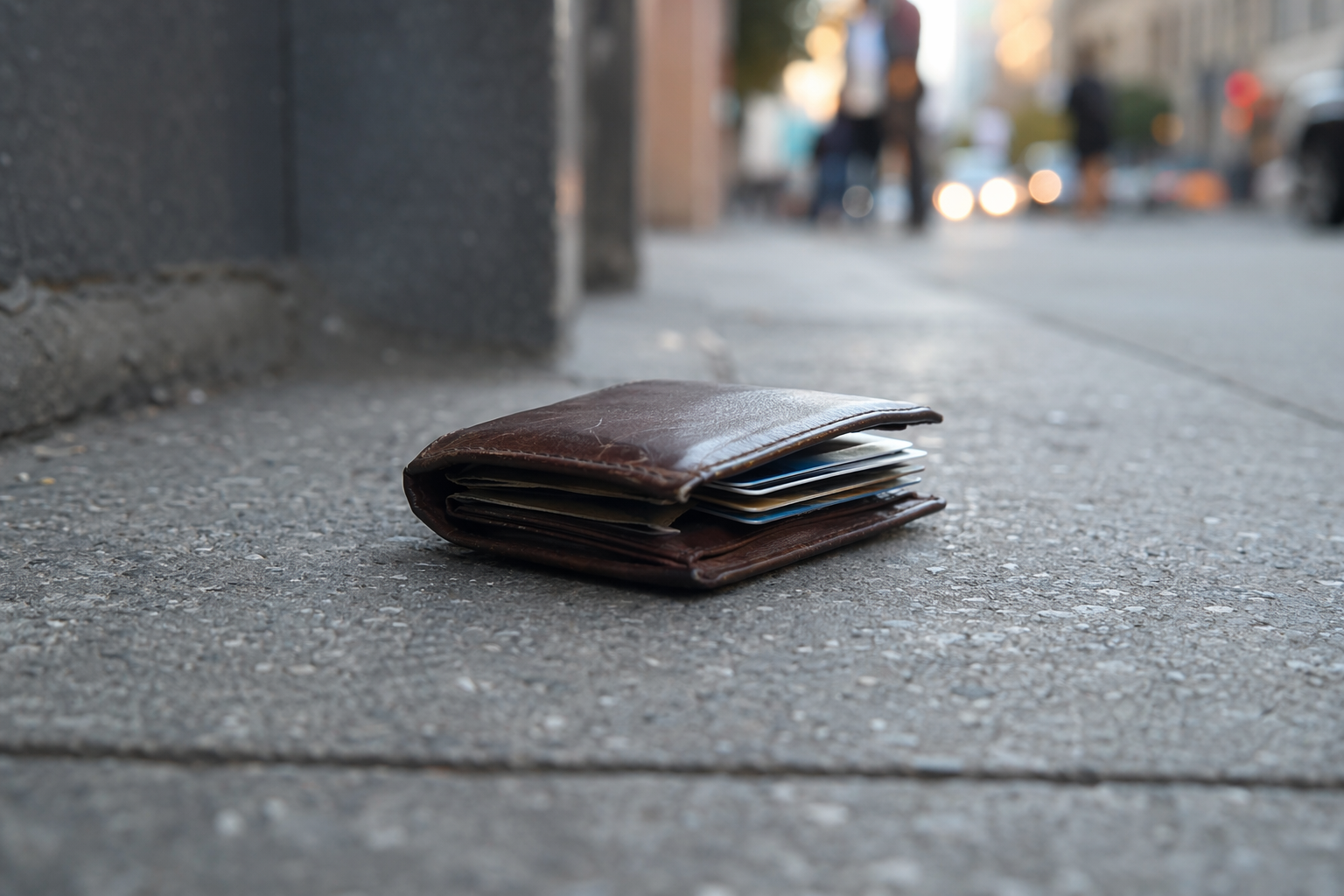
Your wallet is gone. Before you spiral, know this: most wallets turn up within 24 hours, and the steps that actually protect you take less time than you think. Work through the steps below in order — the sequence matters.
Step 1 — Search properly first (don't cancel cards yet)
Canceling a card is irreversible — new cards take 5–10 days. Before you make that call, spend 15 minutes on a real search.
- Every coat and jacket pocket — including the one you wore yesterday
- Your car — under the seat, between the console and the seat, in the door pocket
- The last restaurant, bar, or café you visited — call them directly and ask for the host or manager
- Your gym locker — or the counter at the front desk if you checked in
- Your bag or backpack — inside pockets, behind the laptop sleeve
- Your home couch cushions and nightstand — wallets migrate in your sleep
Still not found? Move to Step 2 — but don't cancel yet. Freezing is the right move first.
Step 2 — Freeze your cards immediately (not cancel)
Freezing is reversible. Canceling is not. Every major bank lets you freeze a card in under 60 seconds from their app — this blocks all new charges while leaving the card alive. If the wallet turns up tomorrow, one tap unfreezes it. If you cancel, you wait a week for new plastic.
How to freeze by bank:
- Chase: App → Account → Card details → Lock card
- Bank of America: App → Cards → Manage card → Lock/unlock
- Wells Fargo: App → Accounts → Card Controls → Freeze
- Capital One: App → Account → Card Lock
- Citi: App → Services → Lock/Unlock Card
- American Express: App → Account → Card Management → Freeze
No app access? Call the number on the back of another card or go to the bank's website. Tell them you want to freeze, not cancel.
Step 3 — Cancel and report if still missing after 24 hours
After 24 hours with no sign of your wallet, it's time to make the cancellation calls. Here's how those calls go:
- Call the number on a recent statement (or your bank's website) — not the one you remember off the top of your head.
- Say: "My card was lost and I'd like to report it and request a replacement." They'll ask for your SSN last 4, address, and recent transaction to verify identity.
- Ask about expedited delivery — most banks will rush a replacement for free if you ask explicitly.
- Dispute any unauthorized charges you notice while on the call — federal law (FCBA) limits your liability to $50 if reported promptly; most banks go to $0.
- Update any autopay or subscriptions linked to the old card as soon as the new one arrives.
Standard replacement timelines: most debit and credit cards arrive in 5–7 business days. Expedited delivery is usually 1–2 business days. Ask every issuer — it costs nothing.
Step 4 — Driver's license replacement
A lost driver's license requires a visit to your local DMV (or equivalent state agency). Here's what to expect:
- What you need: proof of identity (passport, birth certificate, or another government ID), Social Security number, and proof of address (utility bill or bank statement)
- Fee: typically $10–$35 depending on your state
- Timeline: most states mail the replacement within 7–14 days; some issue a paper temporary license on the spot
- Temporary license: accepted for driving in most states but may not satisfy TSA requirements for domestic flights
- Flying without a license: TSA accepts a valid passport, passport card, DHS trusted traveler card (Global Entry, NEXUS), military ID, or permanent resident card as alternatives — check the TSA website for the current complete list
- Can you drive while waiting? Yes, if the DMV issues a paper temporary — carry it with you at all times
Step 5 — Fraud alert + credit freeze
Your ID was in that wallet. That means someone has your name, address, and possibly your SSN if a Social Security card was inside. Take both steps below — they're free, they take 10 minutes total, and the protection lasts.
Fraud alert — tells lenders to take extra steps to verify identity before opening new accounts in your name. Set it at one bureau; they notify the other two automatically. It lasts 1 year (7 years if you're an identity theft victim).
Credit freeze — locks your credit file entirely so no new credit can be opened, period. Set it at all three bureaus individually. It doesn't affect your existing accounts or credit score. Free and reversible.
- Equifax: equifax.com → Freeze Credit, or call 1-800-685-1111
- Experian: experian.com/freeze → Add a Security Freeze, or call 1-888-397-3742
- TransUnion: transunion.com → Credit Freeze, or call 1-888-909-8872
Recommendation: set the fraud alert first (it's one call), then freeze all three bureaus. Do both even if your wallet only had cards and no ID — the combination is your cheapest insurance.
Step 6 — Monitor your accounts going forward
Identity theft from a lost wallet doesn't always happen in the first 48 hours. Sometimes stolen information gets packaged and sold, used weeks or months later. Here's your ongoing checklist:
- Check bank and card statements weekly for the first 90 days — look for small test charges ($0.01–$5) before a larger fraud attempt
- Monitor your credit report monthly — annualcreditreport.com provides free weekly reports from all three bureaus
- Watch for bills or collection notices for accounts you never opened
- Check your IRS tax transcript the following filing season — tax identity theft is common when someone has your SSN
- Set up transaction alerts on all cards that don't already have them — most banks send a push notification for every purchase
- Risk window: the heightened risk period is typically 12–18 months after a theft; after that, most stolen credentials have been cycled out of criminal databases
If someone found it honestly
Most people who find a wallet want to return it. Studies consistently show that honest finders return wallets at higher rates than most people expect — especially when there's an easy, no-awkwardness way to do so.
The problem is contact. Without your phone number or email, an honest finder has no way to reach you without doing something that feels invasive — looking up your address, searching your name on social media. Many well-meaning finders just hand it in to a venue's lost-and-found rather than go through that friction.
A Tagback QR card or sticker inside your wallet removes all that friction. The finder scans the QR with any smartphone — no app needed — and gets a one-tap "message owner" button. You get an instant notification: "Someone has your wallet." They see your first name and a reply form. No address, no phone number exposed. "Lost Mode" shows in your Tagback dashboard so you know the item is in someone's hands.
It's the difference between a finder thinking "I should really try to return this" and actually being able to. The tag gives them a path.
Replace everything that was in the wallet — checklist
Once the immediate financial damage is contained, work through this checklist. Not everything needs to happen today — prioritize by what blocks you.
- Debit and credit cards — call each issuer (covered in Step 3)
- Driver's license — DMV visit (covered in Step 4)
- Health insurance card — call your insurer; most replace via mail within a week; many apps show a digital card immediately
- Auto and home insurance cards — download via your insurer's app or request a new copy online
- Medicare/Medicaid card — order a replacement at ssa.gov (Medicare) or your state Medicaid office
- Transit pass or metro card — visit or call your transit authority; most can transfer remaining balance to a new card if you have the card number on an old statement
- Gym membership card — usually free at the front desk with your account info
- Library card — free to replace at your library branch
- Loyalty cards (airline, hotel, grocery) — log into each account and print or download the app card; most never need physical plastic
- Business cards, personal contacts — if you stored anything paper in your wallet, note what's gone and rebuild from email or digital sources
- Cash — unrecoverable; this is the actual loss that stings and also the smallest part of the long-term risk
FAQ
Should I cancel or freeze my cards first?+
Freeze first, always. Freezing blocks new charges instantly and is completely reversible — if your wallet turns up, one tap in the app restores the card. Canceling triggers a 5–10 day wait for new plastic and closes the card permanently. Only cancel after 24 hours of confirmed loss.
How long until new cards arrive?+
Standard delivery is 5–7 business days for most US banks. Ask for expedited delivery when you call — it's almost always free and takes 1–2 business days. If you have pending bills or travel within the week, ask explicitly; most banks accommodate it.
What if someone is already using my cards?+
Call your bank immediately and report the unauthorized charges. Under the Fair Credit Billing Act (FCBA), your maximum liability for unauthorized credit card charges is $50 — and most banks go to $0. For debit cards, the rules are slightly different: report within 2 days for $50 liability, or up to 60 days for $500. The faster you call, the better your protection.
Can I fly without a driver's license?+
Yes, with acceptable alternatives. TSA accepts a valid US passport, passport card, military ID, DHS trusted traveler card (Global Entry, NEXUS, SENTRI), or permanent resident card. A DMV-issued paper temporary license may also work. Check TSA.gov for the full current list before your flight, as requirements update periodically.
Start protecting what matters
Tagback is free, forever. No subscription. No app needed for finders.
Create your free tag