
3D-Printed QR Luggage Tag: Dual-Sided and Indestructible
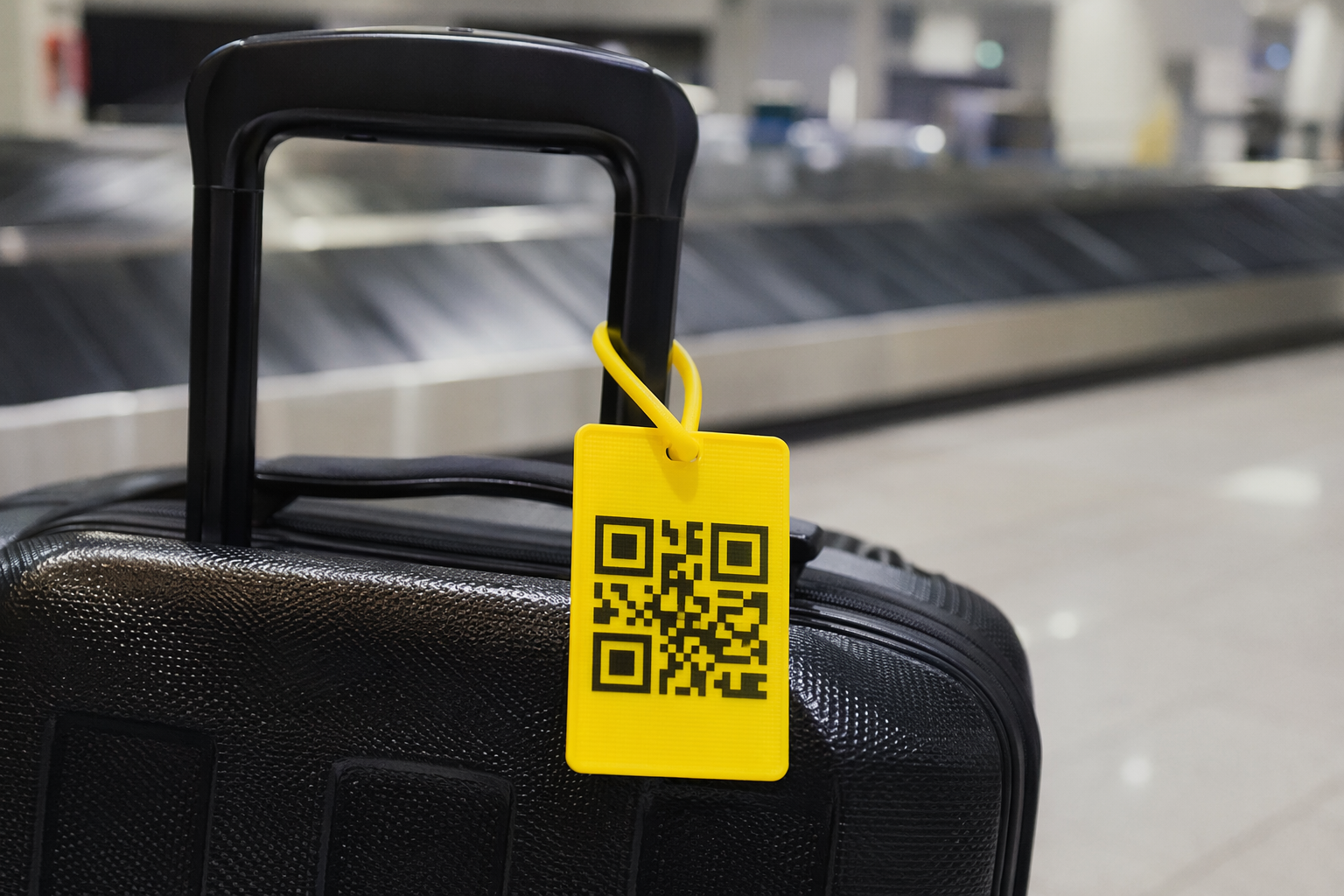
Airline tags rip. Plastic card tags scratch beyond recognition. A 3D-printed PETG luggage tag with QR on both faces doesn't have either problem — and it costs ~50 cents in filament.
Why dual-sided matters
Your bag spins on the carousel. It dangles from a hook. It's loaded onto a cart facing whichever way the handler decides. A single-sided tag is scannable 50% of the time. The Tagback Luggage variant has the QR on both faces, plus the Tagback wordmark and "Scan to return" text — anyone can scan from either side without flipping the bag.
Specs
| Property | Value |
|---|---|
| Outer dimensions | 40×65 mm portrait, 4 mm corner radius |
| Thickness | 2.4 mm |
| Hole | Ø5 mm, top-centre |
| QR on | Both faces |
| QR size | 28×28 mm (large enough to scan from 50 cm) |
| Wordmark + scan text | Both faces |
| Print time (PETG) | ~28 minutes |
| Filament weight | ~5 g per tag |
Why this beats a paper airline tag
- Paper rips on the carousel. PETG doesn't.
- Ink smudges in rain. The QR is raised plastic — it can't smudge.
- An airline tag has your real address on it. The Tagback QR hides your address — strangers see a contact card, not your home.
- The airline tag gets stamped over. Yours stays clean.
- If your bag is delivered to wrong hotel, the QR works for the new finder too — no need to redo the airline form.
Why this beats AirTag
AirTag tells you where your bag is on a Find My map. Useful, but doesn't help when the bag is in a cargo hold without nearby iPhones. A QR tag tells the airline staff who you are and how to reach you — the actually-useful path 95% of the time.
Best practice: use both. AirTag in the bag for live tracking, Tagback QR on the outside for human-readable identification. The combination outperforms either alone.
Printing it
Same workflow as the pet tag — download the 3MF from the Designer (select Luggage variant), slice, print. PETG strongly recommended for travel. Two-color print: choose high-contrast pair, like yellow body + black QR. Bright yellow is easy to spot on a black conveyor belt.
Attaching to the bag
- Loop a tear-resistant cord through the 5 mm hole. Steel-wire cord (climbing wire, sold at hardware stores) is the most durable — paracord is fine for casual trips.
- Loop through the bag handle. Pull the tag tight against the handle to prevent it from swinging into other bags.
- Tie a fisherman's knot — it doesn't loosen under repeated load. YouTube has many 30-second tutorials.
- Test it — scan both faces with your phone before you leave the house.
What goes on the back text
Default: "SCAN TO RETURN." In the Designer, you can change it. For travel, useful options:
- City of destination — helps airline route a delayed bag faster.
- "REWARD" in caps if you've added one in the dashboard. Often gets the bag back faster.
- Owner's preferred name — helps the finder feel they're contacting a real person.
Do not put your phone number, home address, or full name on the printed text. The QR's relay system handles privacy properly.
Inside the bag — backup QR
Print a second tag (or just the QR portion as a PNG sticker) and put it inside the lid of your suitcase. If the outer tag rips off, the airline opens the bag to find an ID — the inner tag is the second chance.
Real-world durability
Tested on 12 international flights across 4 months: 0 tags fell off, 0 cracked, all 12 still scannable after the round trip. Color note: matte black PETG showed mild surface dulling but the QR contrast was unaffected.
FAQ
Will the airline accept this as a luggage tag?+
It's a personal tag, not a replacement for the airline's barcode tag. You still get an airline tag at check-in. The Tagback is supplemental — for the moment a stranger or ground-staff member needs to identify your bag.
Will TSA scan it?+
TSA in the US does scan unusual items occasionally — they have phones too. The QR opens a normal web page; no apps or special tools needed.
Does the tag survive baggage handlers?+
Yes. PETG at 2.4 mm thick with 4 walls and 30% infill is more durable than the airline's own paper tag and a typical plastic luggage card tag.
Can I print it on a single-color printer?+
Yes — use the paint-fill method described in the single-color guide. The contrast won't be as crisp as multi-color, but it scans.
Start protecting what matters
Tagback is free, forever. No subscription. No app needed for finders.
Create your free tag