
Best Luggage Tracker 2026: AirTag vs Tile vs Samsung vs QR Tags Compared
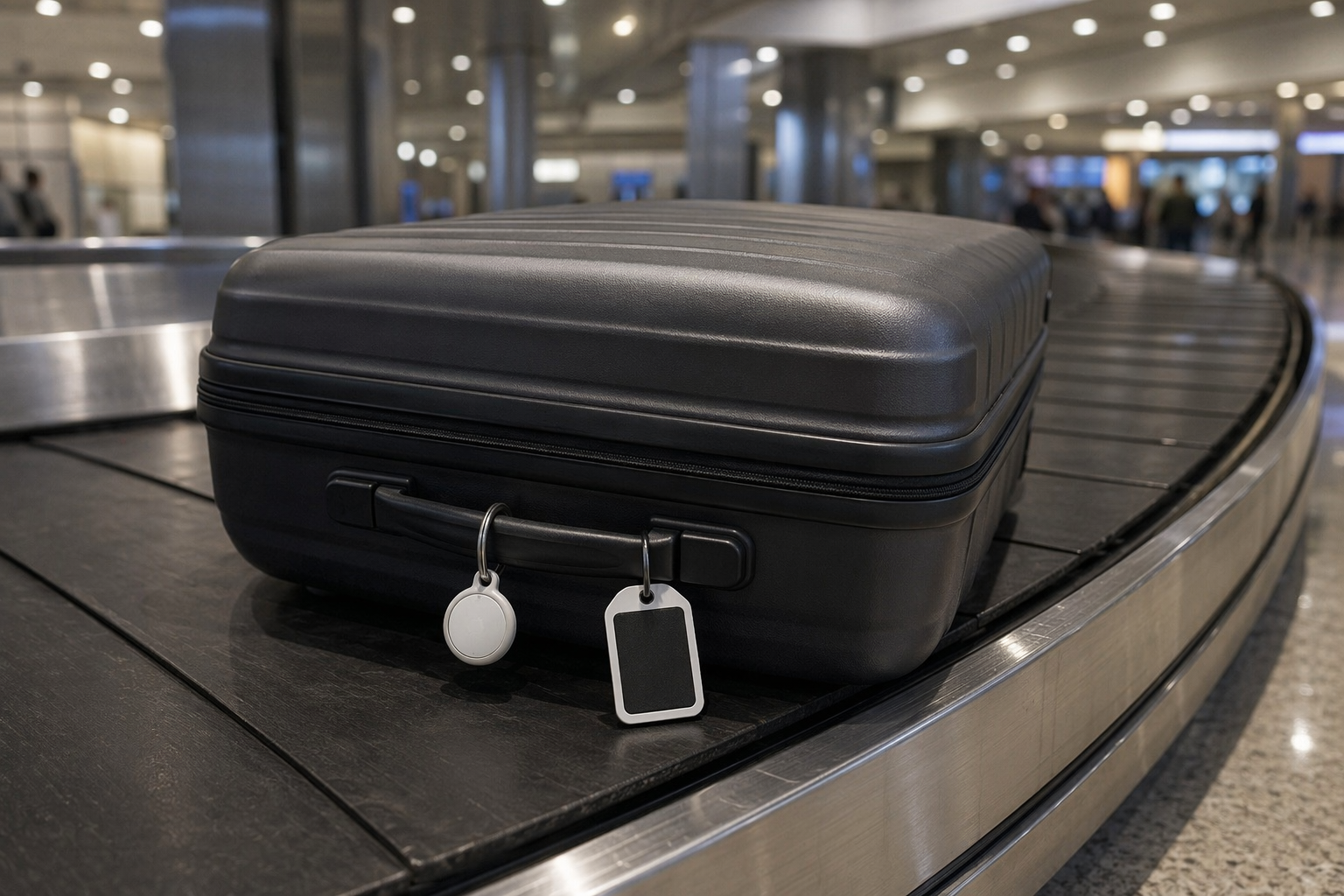
There is no single best luggage tracker. There are three completely different technologies, each with different strengths, failure modes, and cost structures. The AirTag that works brilliantly on your commute is largely useless in a cargo hold. The GPS tracker that gives you live location costs $15 a month forever. The QR tag that works anywhere in the world cannot tell you where your bag is — only put a finder in touch with you. This comparison covers all three honestly, so you can pick the right layer (or combination) for your travel style.
The three fundamentally different approaches
Every luggage tracker on the market falls into one of three categories. Understanding the category tells you most of what you need to know about whether it will help you.
- Bluetooth / UWB trackers (AirTag, Tile, Samsung SmartTag2). These emit a short-range Bluetooth signal. When another device from the same network passes within range, it silently relays the tag's location back to the manufacturer's servers. Range is roughly 10–30 metres outdoors. In a sealed cargo hold with no network devices present, they go silent.
- GPS trackers (Optimus 2.0, LandAirSea 54, similar). These contain a real GPS chip and a cellular SIM. They report their location directly to a server at regular intervals. You can see live location on a map anywhere with cell coverage. They require a monthly subscription for the data plan.
- QR tags (Tagback, similar). Completely passive. No battery, no chip, no signal. A unique QR code is printed on a label. When someone finds your bag and scans it, they land on a contact page that lets them message you anonymously. You get notified; you reply; you arrange return.
Each category answers a different question. Bluetooth answers: where did my bag last show up on the network? GPS answers: where is my bag right now? QR answers: how does the person holding my bag reach me?
Apple AirTag for luggage — when it's the right choice
AirTag is the most polished Bluetooth tracker available. The Apple Find My network — passively built from hundreds of millions of iPhones — gives it enormous passive coverage in any urban environment. When your bag rolls off the carousel at a busy international airport, there are enough iPhones nearby that the AirTag will show you exactly where the bag surfaced.
In checked luggage: works, with limitations. Airlines permit passive Bluetooth trackers in checked bags. AirTag is allowed. However, the cargo hold is effectively a signal-dead environment — metal walls, no iPhones passing through. Your AirTag will show its last known location from when it was last pinged (typically the check-in hall or gate area). It will update again once the bag is in a baggage hall or near ground staff with iPhones. Some European airlines (Lufthansa notably) flagged concerns in 2022, but as of 2026 global airline rules permit passive Bluetooth trackers in checked bags. Check your airline's current policy before flying.
- Best case: you and any nearby finders have iPhones. Coverage is dense, updates are fast.
- Worst case: your bag is in an airport or city with low iPhone density. The AirTag may not update for hours.
- Ecosystem lock-in: AirTag only works with the Apple Find My app. Android users cannot track an AirTag even if they own it.
- Cost: ~$29 per tag. No subscription required.
- Battery: CR2032 coin cell, user-replaceable, lasts about a year.
AirTag is the right choice if you and the people most likely to encounter your lost bag are in the Apple ecosystem. It is the wrong choice if you travel primarily to markets where Android dominates (most of Asia, Latin America, Eastern Europe) — in those regions, Find My network density is thin.
Tile and Samsung SmartTag2 — for non-Apple users
Tile was the original Bluetooth tracker and remains the best option for cross-platform households. The Tile app runs natively on both Android and iOS, and any phone with Tile installed acts as a passive relay — giving Tile a meaningful network in most cities.
- Tile Mate (~$24): no subscription required for basic tracking. Tile Premium (~$30/year) adds Smart Alerts, location history, and free battery replacements. Basic use without Premium is genuinely functional.
- Network size: smaller than Apple's Find My, but cross-platform. In Android-heavy markets Tile can outperform AirTag.
- Privacy note: Tile was acquired by Life360. Read the privacy policy if data sharing concerns you.
Samsung SmartTag2 is the right choice for Samsung Galaxy phone users. It supports UWB precision finding (directional arrows to the tag, similar to AirTag on iPhone), has a strong 6-month battery life, and integrates tightly with Samsung's SmartThings Find network. The drawbacks: it only delivers full features on Samsung Galaxy devices. Non-Samsung Android phones lose UWB and some SmartThings features. There is no iOS app at all.
- SmartTag2 (~$29): best hardware for Galaxy users, narrow ecosystem for everyone else.
- SmartThings Find network: uses only Samsung devices as relays, which limits passive finding in non-Samsung markets.
- Cargo hold behaviour: identical to AirTag — goes silent, shows last location, updates when bag enters a passively networked space.
For luggage specifically, Tile is the more practical Bluetooth option for most non-Apple users because it works regardless of which Android phone you carry, and its network is genuinely global.
GPS trackers for luggage — is the subscription worth it?
GPS trackers give you real-time location on a map, anywhere with cell coverage. This sounds perfect for luggage, and for high-value bags it can be. But the tradeoffs are significant.
| AirTag | Tile Mate | Samsung SmartTag2 | GPS Tracker | QR Tag (Tagback) | |
|---|---|---|---|---|---|
| Technology | Bluetooth / UWB | Bluetooth | Bluetooth / UWB | GPS + Cellular | Passive QR |
| Works in cargo hold | No — last location only | No — last location only | No — last location only | Yes (with cell signal) | N/A — finder-initiated |
| Real-time location | No | No | No | Yes | No |
| Battery life | ~1 year | ~1 year | ~6 months | Weeks (varies) | None — no battery |
| Monthly cost | None | None (Premium $2.50/mo optional) | None | $10–25/mo | Free forever |
| Upfront cost | ~$29 | ~$24 | ~$29 | $30–80 | Free |
| Works on Android | No | Yes | Samsung only | Yes (via app) | Yes — any phone camera |
| Ecosystem required | iPhone | Android or iPhone | Samsung Galaxy | Any smartphone | Any smartphone with camera |
| Works if finder has no app | NFC only | No | No | No | Yes — opens in browser |
GPS trackers that work well for luggage include: the Optimus 2.0 (~$40 upfront, plans from $10/month) and LandAirSea 54 (~$36 upfront, plans from $10/month). Both give you live map tracking and are compact enough to fit in a luggage pocket.
- Genuine advantage: you can watch your bag move through cargo in real time, provided the cargo hold has cell coverage (many do).
- Battery reality: live GPS reporting drains batteries fast. Most GPS trackers last 1–4 weeks on a charge, not months.
- Subscription is permanent: $10–25/month, every month, forever. A $40 tracker costs $160 in its first year.
- Best use case: frequent travellers with expensive gear — camera equipment, musical instruments, medical devices — where the cost of loss justifies the subscription.
- Overkill for: casual travel or standard luggage where Bluetooth and QR together cover most real scenarios.
One important nuance: even GPS trackers do not help if the bag is genuinely lost inside airline infrastructure (wrong sort facility, mis-tagged, in storage). The airline's own WorldTracer system is the primary tool there. GPS helps you confirm the bag's location and add pressure in an airline conversation, but it does not replace filing a Property Irregularity Report.
QR luggage tags — free, worldwide, no battery to die
QR tags are not trackers. They cannot tell you where your bag is. What they do is solve a different — and extremely common — problem: a finder has your bag and has no way to reach you.
The majority of lost bags are not lost in the airline system. They are left at hotels, airport lounges, taxis, train stations, and restaurants. In those scenarios, there is an honest person holding your bag who would happily return it if they could contact you. No Bluetooth signal helps here. No GPS is needed. What you need is for the finder to be able to message you in seconds, with no app download, from any phone on the planet.
That is exactly what a QR tag does. Tagback is completely free — no subscription, no paid tiers, no limit on the number of tags you create. Ever. Each tag has a unique QR code linked to an anonymous contact page. When scanned, the finder can send you a message without seeing your phone number or email. You get an instant notification, reply, and arrange return.
- No battery. A QR sticker works for the life of the label — years, not months.
- No app required for the finder. Any smartphone camera opens the contact page in a browser.
- Works anywhere in the world. No network density issues — the finder just needs internet access.
- Limitation: requires an honest finder. If the bag is deep in airline infrastructure with no human picking it up, a QR tag cannot help until a person physically handles the bag.
- Works alongside Bluetooth. Many travellers use both — a Tile or AirTag for active location tracking, a Tagback QR tag for the finder-contact scenario.
- Free. Create as many tags as you want at tagback.org. No credit card required.
One practical tip: attach a QR tag both outside the bag (visible to any finder) and inside the lid (in case the outer tag is damaged or torn). The inside tag means airline staff who open the bag to verify identification can still reach you — which is exactly when a lost-bag case gets resolved quickly.
The two-layer strategy: active tracker + QR tag
For most travellers, the best setup is not choosing between a Bluetooth tracker and a QR tag. It is using both, because they cover completely different failure modes.
- Bluetooth or GPS tracker — tells you where the bag is when it goes missing in transit. Useful for confirming a bag made your connection, locating it in a baggage hall, and adding specificity to an airline conversation.
- QR tag — ensures that any person who physically has your bag can contact you instantly, from any phone, in any country, for free.
The scenarios where one fails are exactly where the other succeeds. A Bluetooth tracker in a cargo hold goes silent — but a ground handler who finds a misrouted bag and scans the QR can message you in 30 seconds. A QR tag cannot tell you that your bag turned left at Frankfurt instead of right — but an AirTag update can.
Combined cost of an AirTag (~$29) plus a free Tagback QR tag: $29 total, no monthly fees. Combined cost of a GPS tracker plus Tagback: $30–80 upfront plus $10–25/month. Choose based on how much you travel, how valuable your bags are, and whether real-time location is worth a permanent monthly commitment to you.
The QR tag layer is a no-brainer regardless of which active tracker you choose — or whether you choose any at all. It is free, maintenance-free, and covers the most common lost-bag scenario: a finder who wants to return it but has no way to reach you.
FAQ
Can I put an AirTag in checked luggage?+
Yes — airlines permit passive Bluetooth trackers in checked bags. The AirTag won't alert in the cargo hold (no signal), but it will show its last location when the bag surfaces in the baggage area. Some European airlines (Lufthansa) previously flagged concerns but current global rules allow it. Check your specific airline's policy before flying to be sure.
Do I need a luggage tracker if my bag already has a paper luggage tag?+
Paper tags rip off — about 1 in 150 bags is mishandled by airlines, and the tag is often the first casualty. A QR digital tag survives because it's affixed directly to the bag and holds your contact details even if the paper tag is gone. For airline-level tracking, the airline's own baggage system is your main tool; personal trackers help after the bag leaves the carousel.
What's the cheapest way to track luggage?+
A QR tag is free — create one at tagback.org and attach it to your bag. It won't show GPS location, but it means anyone who finds your bag anywhere in the world can contact you instantly without an app. For active tracking, Tile Mate is around $24 with no subscription required for basic use.
Are luggage trackers worth it for domestic flights?+
For domestic flights with a direct connection, mishandling rates are low (about 0.5%). A QR tag provides peace of mind for near-zero cost. Active trackers are most valuable for international connections, long layovers, or if you're flying with expensive gear.
Start protecting what matters
Tagback is free, forever. No subscription. No app needed for finders.
Create your free tag