
Cat Keeps Escaping? 8 Methods That Actually Work
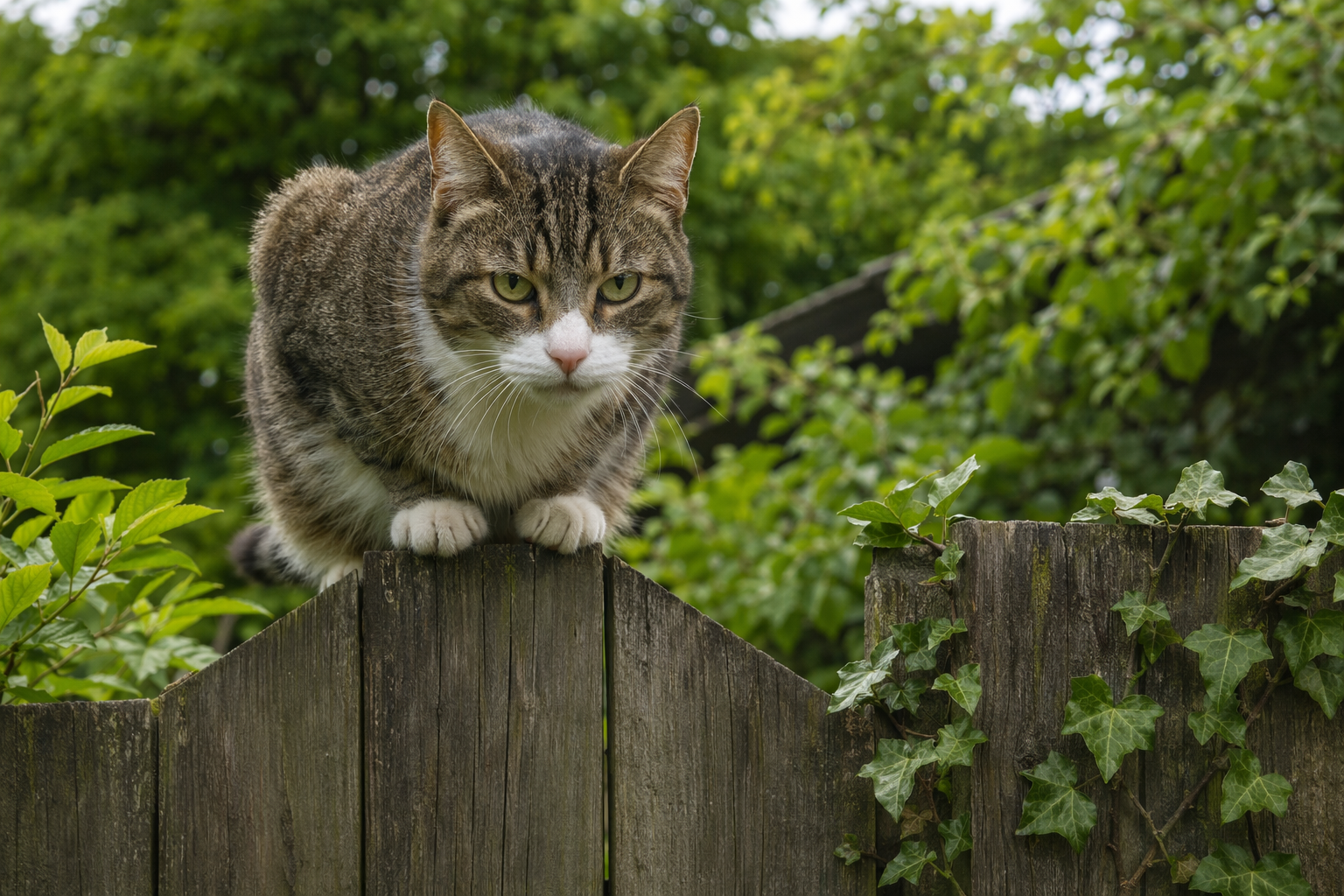
If your cat keeps escaping, you're not being careless — you're up against millions of years of evolution. Cats are territorial, curious, and built to roam. The good news: there are eight proven methods to keep them in. The bad news: which ones work depends almost entirely on why your cat is escaping in the first place.
This guide covers both — the root causes and the fixes, matched to each type of escape artist. Read the causes first. Then pick the methods that fit your cat.
Why cats escape (and why knowing matters for the fix)
A cat bolting out the front door every time it opens is a different problem from a cat systematically working at a garden fence. The method that stops one often does nothing for the other.
- Boredom. An under-stimulated indoor cat treats escape as entertainment. If the outside world is more interesting than the inside one, they'll keep trying to get to it. This is the most common driver and the most fixable.
- Prey drive. A bird, squirrel, or insect on the other side of the window or garden fence triggers a hard-wired chase instinct. The cat isn't choosing to leave — they're responding to a stimulus they can't override.
- Mating urge in intact cats. Unspayed females in heat will make determined, relentless escape attempts. Unneutered males can detect a female in heat from a significant distance and will route over, under, or through almost any barrier.
- Territory pressure in multi-cat homes. When a cat feels crowded — not enough space, resource competition, stress from other cats — the outside starts to look like relief. Escape becomes the path of least resistance.
- Stress and anxiety. Changes in the household (new baby, new pet, building work, a new outdoor cat in the neighbourhood) can push a previously content indoor cat to start escape attempts that didn't exist before.
Once you've identified your cat's motivation, match it to the right fix below. Most chronic escape artists need two or three methods at once — containment and enrichment, for example, not just one or the other.
Door bolters: the airlock method and door training
Door bolting — sprinting for the exit the moment it opens — is one of the most common and most dangerous escape types. It's fast, it's habitual, and it puts the cat directly onto a street or path. Two methods tackle it directly.
- Method 1 — The door airlock (double-door system). Install a second door, baby gate, or screen-door barrier inside the entrance so that to reach the outside, the cat must pass through two closable thresholds rather than one. When the front door opens, the cat hits the airlock and goes no further. This works even with delivery drivers and visiting children who don't know to watch for a bolting cat. Even a tension-mounted baby gate with a small inward-angled overhang is usually enough — cats can jump, but not easily over a barrier that curves back toward them.
- Method 7 — Clicker training for door manners. Teach your cat to sit or step back on cue when a door opens. Start by rewarding any voluntary movement away from the door with a high-value treat; over days, shape this into a deliberate 'back' or 'sit' cue at the threshold. This takes 2–4 weeks of consistent practice but it works — cats are trainable, they just require the right motivation (usually food). Combine with the airlock for belt-and-braces protection.
Window and balcony escapers: screens, nets, and guards
Windows are the most overlooked escape route. Cats are excellent jumpers and climbers, and a cracked window for ventilation is effectively an open invitation. Balconies present the same problem — cats have no instinctive fear of heights and will jump from surprising distances.
- Method 4 — Window screens and guards. Fit cat-specific mesh screens to every window you open regularly. Standard fly screens aren't strong enough — cats simply push through them. Purpose-built cat window guards use a heavy-duty mesh frame that clips or screws into the window reveal. For balconies, use a cat-containment net stretched across the open face. These take an afternoon to install and eliminate the window escape route entirely.
For high-rise balconies: high-rise syndrome (falls from balconies and windows) injures far more cats than most owners realise. Window guards and balcony nets solve both the escape risk and the fall risk simultaneously — one investment, two serious hazards removed.
Garden cats: cat-proof fencing and catios
If your cat has garden access and keeps leaving it, or if you want to give an indoor cat safe outdoor time, physical containment of the outdoor space is the best solution. Two approaches dominate, and they can be combined.
- Method 2 — Cat-proof garden fencing. Standard garden fences are easily scaled by cats — they're designed to keep dogs in, not cats. Cat-proof fencing works by adding an inward-rolling or angled topper that physically prevents a cat from completing the climb over the top. Systems like ProtectaPet or Oscillot attach to existing fences and walls without replacing them. They work on brick, timber, and panel fencing alike, and once fitted are nearly invisible from a distance. The minimum effective spec is 1.8 m fence height plus a 30 cm inward overhang; anything lower and an athletic cat will clear it with a running jump.
- Method 3 — Catio (enclosed outdoor enclosure). A catio is a fully enclosed outdoor space — anything from a small window-box enclosure to a large freestanding run in the garden. It gives cats outdoor stimulation (fresh air, bird-watching, smells, sunlight) without access to roads, neighbouring gardens, or unfamiliar animals. Cost ranges from a DIY build of around $50–150 using timber and galvanised mesh, to professionally installed custom structures at $1,000–2,000+. Even a small window-box catio significantly reduces escape urge by giving the cat a legitimate 'outside' to access on its own terms.
The 3 changes that reduce escape urge from the inside (enrichment, spay/neuter, stress reduction)
Physical containment stops the escape. These three methods reduce the desire to escape — which is the more durable fix, and essential for cats where anxiety or biology is the underlying driver.
- Method 5 — Enrichment for bored indoor cats. A bored cat will treat any gap in your defences as a project. An enriched one has better things to do. The essentials: window perches at bird-watching height; puzzle feeders at meal times (swap the bowl — make them work for food); at least two 10–15 minute interactive play sessions per day with a wand or feather toy; and vertical space (cat trees, wall shelves) to patrol. For multi-cat homes, ensure each cat has its own feeding station, litter tray, and resting area. Resource competition is a silent but significant driver of escape attempts.
- Method 6 — Spay and neuter. If your cat is intact, this is the single highest-impact change you can make. Neutering reduces roaming urge by around 80% in males and eliminates the hormonal drive to escape in females in heat. The effect is not gradual — most owners see a marked drop in escape attempts within weeks of the cat recovering from the procedure. For males who have been roaming for some time, the learned behaviour may persist briefly after neutering, but it fades without the hormonal reinforcement.
- Stress reduction for anxious cats. If escape attempts started after a specific household change, address the stressor directly. For multi-cat tension: add resources so cats don't need to compete; use Feliway MultiCat diffusers; ensure each cat has a private zone. For new-baby or building-work anxiety: provide a quiet room as a refuge and maintain play and feeding routines as closely as possible. An anxious cat that has a safe, predictable indoor environment rarely has the motivation to escape it.
The safety net: ID for when prevention isn't enough
No method is 100%. A visitor leaves a door ajar. A storm damages a fence panel. A delivery driver props the gate. The best outcome after a cat escapes is a fast reunion — and that depends entirely on whoever finds your cat being able to reach you immediately.
Method 8 — QR ID tag as the safety net. An engraved tag with a phone number is better than nothing, but numbers fade, change, or go to voicemail. A Tagback QR tag works differently: any person who finds your cat scans the tag on their smartphone — no app needed on their end — and instantly sees your contact details, your cat's name, and a message from you. You get a notification the moment the tag is scanned, with the GPS location of the scan.
- No app needed for the finder. Anyone with a smartphone camera can scan it — it opens instantly in the browser. The person who finds your cat is probably a neighbour, not a vet.
- Lost Mode. Activate it when your cat goes missing and every scan sends you an instant alert with the scanner's location. You know the moment someone has found them and exactly where.
- Stores everything a finder needs: your contact details, vet number, medical notes, and any special instructions for the cat.
- Works for indoor cats especially. Indoor cats are the least likely to wear ID — and the most likely to be found by a confused neighbour who doesn't know if they're lost or just visiting. A QR tag resolves that confusion in 10 seconds.
- Tagback is completely free. No subscription, no per-tag fee, no paid tiers — ever. Create a profile, print the QR, attach it to a breakaway collar. There is no reason for any cat not to have one.
Always use a breakaway collar — not a standard buckle collar. Cats can get collars caught on branches, fence gaps, or garden furniture. A breakaway collar releases under pressure; if the cat gets caught, it pops free instead of causing injury. This is non-negotiable for any cat wearing a collar outdoors.
Layered prevention is the goal: address the motivation (enrichment, spay/neuter, stress reduction), harden the containment (airlock, fencing, catio, window guards), train the behaviour (door manners), and put a safety net in place for the days everything is tested. No single fix is foolproof. All eight together get very close.
FAQ
Is it cruel to keep a cat indoors?+
No — indoor cats live significantly longer on average (12–18 years vs 2–5 years for outdoor cats due to traffic, predators, and disease). The key is enrichment: window perches, puzzle feeders, interactive play, and vertical space. A bored indoor cat will escape; an enriched one won't try as hard.
My cat scratches at the door constantly. How do I stop it?+
Door-scratching is almost always a demand behaviour — the cat has learned that scratching opens the door. Stop letting it work: ignore the scratching entirely (even to tell it to stop), and only open the door when the cat is calm. This takes 1–3 weeks of consistency. Combine with enrichment to reduce the underlying boredom.
Does a catio actually stop cats escaping?+
Yes — a fully enclosed outdoor enclosure is the closest thing to a perfect solution. Cats get outdoor stimulation without access to roads or neighbouring gardens. Cost ranges from DIY (around $50) to custom-built ($2,000+). Even a small window-box enclosure reduces the escape urge significantly.
My cat has been an outdoor cat for years — can I transition it to indoor only?+
Yes, but gradually. A cold-turkey transition causes significant stress and increases escape attempts. Start by keeping the cat in for progressively longer stretches, adding enrichment at each stage, and providing a catio or window perch as an outdoor-stimulus substitute. Most cats adapt within 3–6 months.
Start protecting what matters
Tagback is free, forever. No subscription. No app needed for finders.
Create your free tag