
Indoor Cat Escaped Outside: Step-by-Step Guide to Bringing Them Home
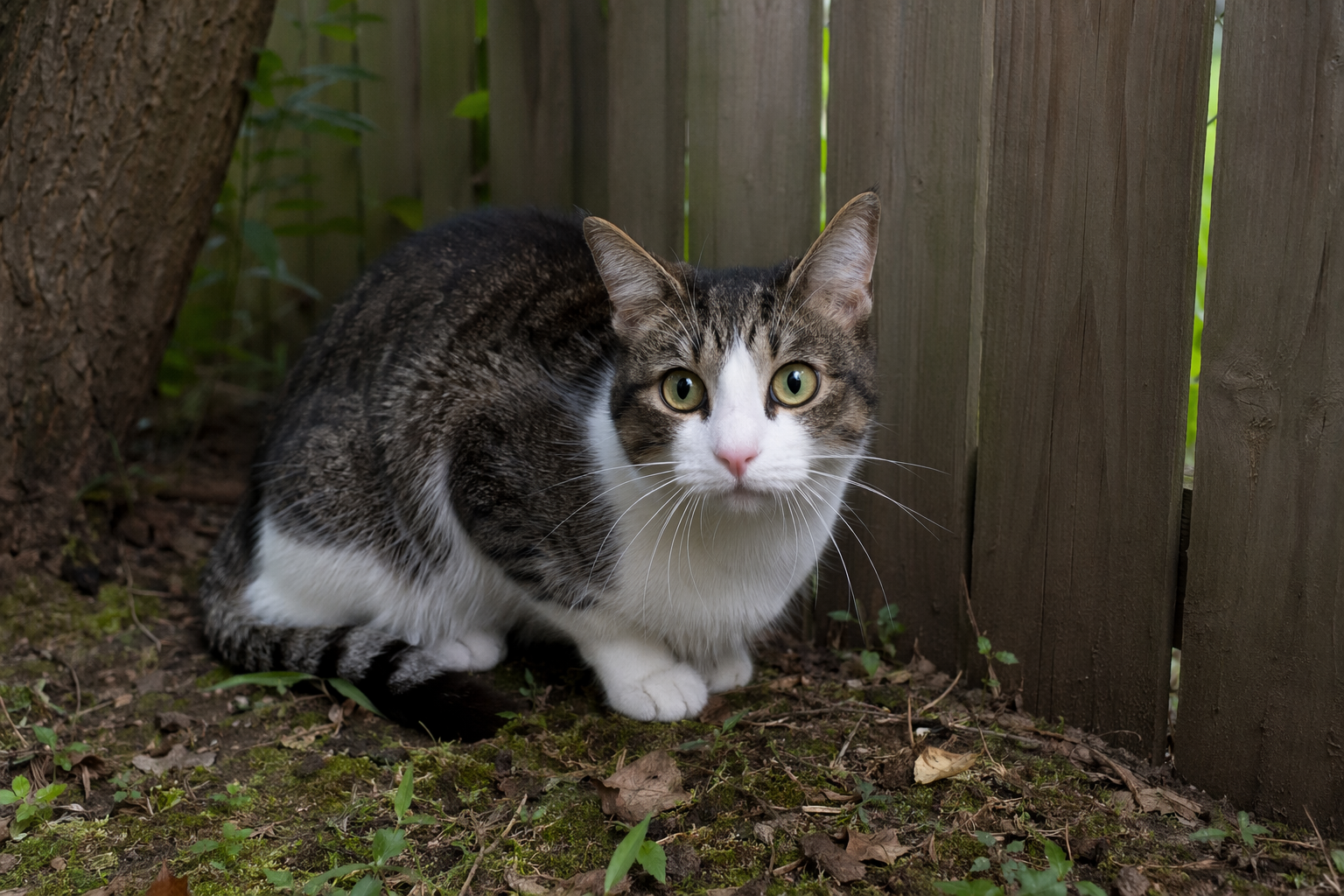
Take a breath. Your indoor cat is almost certainly still close by. 75% of escaped indoor cats are found within 500 metres of home — but only if you search the right way. The instincts that indoor cats rely on outside are completely different from those of outdoor cats, and the standard advice (call their name, search widely, post on social media) can actually work against you in the first few critical hours.
This guide walks you through exactly what to do, in the right order — starting right now.
Don't run after them — understand how indoor cats behave outside
The single most important thing to understand: an indoor cat outside is not exploring. They are terrified. Their entire world has been replaced by noise, smells, open space, and unfamiliar animals. Their response is not curiosity — it is fight-or-flight, and almost every indoor cat chooses to freeze and hide.
- They don't roam — they press into the smallest, darkest space they can find. A gap behind an AC unit, under a porch, inside a neighbour's shed. If it's dark and enclosed, your cat has considered it.
- They go completely silent when frightened. Unlike outdoor cats, indoor cats do not meow when scared. Calling their name and waiting for a response will not work — any sound feels like a threat, so they suppress every instinct to answer.
- They stay hidden even when they hear your voice. A frightened cat will recognise your voice and still not come out. The sound of someone familiar does not override the fear response. This is normal and not a sign they've gone far.
- They stay extremely close to the escape point. Most indoor cats in panic mode travel less than 100 metres in the first few hours. The fact that you can't see them doesn't mean they've left the area.
Minutes 0–30: Search the immediate hiding spots first
Before you go anywhere, search methodically. Panic makes this hard — but a systematic sweep of close hiding spots is more likely to find your cat than a wide search of the neighbourhood.
- Check inside the house again, thoroughly. Cats escaping a scare sometimes double back. Check under every bed, inside every wardrobe, behind the fridge, inside the washing machine drum, inside bags and boxes, behind any appliance that creates a warm dark gap.
- Step outside slowly — no running, no shouting. Move at a crouch. Bring a flashlight even in daylight; you're looking for eye-shine in dark gaps. Check under the porch, behind the AC unit, under cars in the driveway, inside any open shed or bin store.
- One or two searchers only — zero shouting. A crowd of people calling and moving quickly will push a frightened cat further back into hiding. Keep the search quiet and low.
- Leave the back door or window open. Many indoor cats find their own way back within a few hours when given the chance. Do not close off the escape route.
- Scan every ground-level gap with your flashlight. Look for the green or yellow flash of eye-shine. Cats blink and look away quickly — move the beam slowly and look for the reflection at the edge of dark spaces.
Hours 1–6: Set up the recovery zone
If the immediate search hasn't found your cat, shift from active searching to passive recovery. Cats use scent to navigate — the right scents placed at the right spot can pull them back far more reliably than continued searching.
- Place their used litter box outside at the last known location. This is the single most effective scent anchor. The smell of their own litter travels and is familiar — it signals home. Do not use a fresh, clean box.
- Add worn clothing with your scent. A T-shirt you've slept in, laid flat near the litter box. Your scent reassures them without requiring them to approach a person.
- Put their food bowl outside with strong-smelling food. Tuna, sardines, or wet cat food with a strong odour carries further than dry food. Check every 2–3 hours to see whether it has been touched.
- Set a humane trap baited with strong-smelling food. Position it near the feeding station and litter box. Check every 2–3 hours — especially at dawn and dusk when cats are most likely to move.
- If your cat has a Tagback QR tag, activate Lost Mode now. The profile will show a red alert banner to anyone who scans it, instantly sending you their location. If your cat doesn't have a tag yet, this is the step that tells you why they need one.
Why indoor cats still need a collar and QR tag — the ID gap
Most indoor cat owners skip the collar entirely. The reasoning makes sense: the cat never goes outside, so why bother? But escape scenarios are exactly when a collar and ID matter most — and indoor cats are the least likely to have one.
When a neighbour finds your cat hiding in their shed, they have no way to contact you. The cat looks healthy. They don't know if it's lost or an outdoor cat that wanders. Without any ID, the cat might be taken to a shelter or simply left alone — while you're two streets away not knowing they've been found.
- A Tagback QR tag makes any finder the hero in 10 seconds. They see the cat, scan the tag on their phone — no app needed — and they're immediately looking at your contact details, your cat's name, and a message from you. You get an instant notification with where the scan happened.
- Breakaway collar — not a regular buckle collar. Indoor cats are not used to wearing collars and can panic. A breakaway collar releases under pressure — if the cat gets it caught on something, it pops open instead of strangling. This is non-negotiable for cats.
- Tagback is completely free. No subscription, no per-tag fee, no "upgrade to contact." Create a profile, print the QR, attach it to the collar. A neighbour who finds your cat finds you immediately.
- The microchip gap. A microchip only helps if the cat reaches a vet or shelter with a scanner. A QR tag works the moment any person with a smartphone finds your cat — which is almost always what happens first.
Hours 6–24: Digital search and night sweep
- Post on Nextdoor and local Facebook lost-pet groups. Use a clear, recent photo. Include the cat's name, your street (not full address), and whether they're microchipped. Pin the post.
- Submit to PawBoost — it automatically alerts local volunteers in your area.
- Call or email every vet clinic and shelter within 10km. Describe the cat precisely: colour, markings, collar colour, microchip number. Ask them to check daily.
- Search at dusk and dawn. Frightened cats are most likely to move and peek out at low light when foot traffic drops. Bring a flashlight and crouch low — scan ground level slowly for eye-shine.
- Post physical flyers in a 100-metre radius. Simple, clear photo, your phone number, and the approximate location they escaped from. Focus on lamp posts, garden walls, and the entrances to any nearby blocks of flats or car parks.
After day 3 — don't give up
If your cat hasn't come back or been found in the first 72 hours, it is not too late. Indoor cats have been recovered weeks after disappearing, still within a few hundred metres of home — alive, uninjured, just hidden. The hiding instinct is strong. They may be waiting for the area to feel quiet and safe enough to move.
- Keep the trap baited and check it every 2–3 hours. Do not abandon it.
- Keep the feeding station active. If food is disappearing overnight, you know your cat is nearby — or another animal is. Use a trail camera or phone camera pointed at the station to find out which.
- Keep the shelter alert standing. Call shelters every 2–3 days. Cats are brought in continuously and a match found last week may not have been logged correctly.
- QR tag scans can happen days later. If your cat has a Tagback tag in Lost Mode, you will be notified the moment any neighbour finds and scans it — even a week after the escape. This is why the tag matters even after the first 24 hours.
- Expand the flyer radius gradually. After day 3, move from 100 metres to 300 metres. After a week, 500 metres. The cat may have moved at night.
The single biggest mistake people make is assuming an indoor cat cannot survive outside. Most can, and most stay remarkably close. The second biggest mistake is giving up the search before the cat has had a chance to feel safe enough to emerge. Collar, QR tag, feeding station, humane trap, patience — these are the tools that bring indoor cats home.
FAQ
How far do indoor cats travel when they escape?+
Usually not far at all. Indoor cats in panic mode hide, not roam. 75% are found within 500 metres of the escape point, often in a neighbour's garden or under a nearby structure. In the first few hours, most don't travel more than 100 metres.
Will my indoor cat come when I call?+
Probably not. Frightened cats suppress their response to familiar voices because any noise feels like a threat. Searching silently with a flashlight in hiding spots is more effective than calling. If you do call, do it quietly and only once — then wait and listen.
My cat has been outside for 3 days — is it too late?+
No. Cats can survive extended periods hiding nearby. Keep the trap set, the feeding station active, and continue checking shelters every 2–3 days. Indoor cats are often found alive weeks later, still within a few hundred metres of home.
Should I leave food outside for my cat?+
Yes — at the exact spot they escaped from. Use strong-smelling food (tuna, sardines) and check every 2–3 hours. Placing their used litter box nearby is equally important — the scent of familiar smells, especially their own litter, can guide them back when they feel safe enough to move.
Start protecting what matters
Tagback is free, forever. No subscription. No app needed for finders.
Create your free tag