
Autism Wandering ID: How to Keep Your Child Safe When Every Second Counts
It can happen in a heartbeat. You turn around in a grocery store, answer the door, or step into another room — and your child is gone. For families living with autism, this is not a rare fear. Around half of all autistic children elope — meaning they bolt, wander, or go missing — at least once after age four. Many do it repeatedly. Unlike a typical child who might be found nearby and easily guided home, an autistic child may be non-verbal, unable to give their name, unresponsive to strangers calling after them, or drawn toward water, traffic, or other serious hazards.
Every minute of a search matters. Studies show the first responders who reach an autistic child fastest are most likely to see a good outcome. The single most powerful thing you can do before an elopement happens is make sure your child is carrying some form of identification that works — even when your child cannot speak, cannot cooperate, and cannot be expected to keep it on.
This guide walks through every realistic ID option, from classic engraved bracelets to modern QR tags, so you can choose what fits your child's sensory profile, age, and habits.
Why Standard ID Tags Often Fail for Autistic Individuals
A metal dog-tag on a chain looks like a perfectly reasonable solution — until you factor in what it is actually like to be the child wearing it.
- Sensory sensitivity. Many autistic children are extremely sensitive to texture, weight, and temperature. A metal tag that gets cold in winter or a chain that rubs the neck can trigger distress strong enough to make a child fixate on removing it rather than anything else.
- Removing behaviour. Some children are persistent and inventive when it comes to taking things off. Clasps that seem secure to an adult are a puzzle to be solved for a determined child.
- Verbal communication barriers. Even a child who can speak at home may go almost completely non-verbal under extreme stress or with an unfamiliar adult. A stranger who finds them may get nothing — no name, no parent's number, nothing — unless there is something physical to read.
- Information overload on a small surface. Traditional engraved tags have limited space. A parent's mobile number and the word AUTISM may be all that fits, which is not always enough for a first responder to act on quickly.
- Tag not visible. A tag tucked inside a shirt, or a small disc on a keyring clipped to a bag that has been dropped, may never be found at all.
None of this means ID tags are useless — it means the right ID solution for your child depends on your child. The good news is you have more options than ever.
Medical Alert Bracelets — What to Look For and What to Engrave
A well-chosen bracelet is still one of the most reliable forms of ID because it stays with the body. The key is matching the bracelet to your child's sensory needs.
- Silicone bands are the most sensory-friendly option for most children. They are soft, lightweight, waterproof, and come in bright colours your child may even enjoy choosing. Brands like Road ID and American Medical ID offer customisable silicone bands with a small ID plate.
- Stretch fabric bands are another gentle option — they have no cold metal and no tight clasp, which makes them more tolerable for touch-sensitive children.
- Stainless steel or titanium plates on silicone bands offer durability and legibility that last for years. Avoid nickel, which can irritate skin.
What to engrave: Space is tight, so prioritise. Most families include the child's first name, one or two parent mobile numbers, and a short phrase such as NON-VERBAL — PLEASE CALL or AUTISM — I MAY NOT RESPOND. If your child has a seizure condition or serious allergy, include that too. You do not need to engrave a full medical history — that is what a QR tag or a card in their bag is for.
Shoe Labels and Iron-On Clothing Labels — For Children Who Remove Wristbands
If your child reliably removes any bracelet within minutes, don't give up on ID — just change where it lives.
- Shoe labels stick inside the shoe under the insole, meaning they are invisible to the child and very difficult to remove without fully taking off the shoe. Companies like Mabel's Labels and SafetyTat make waterproof, written labels sized to fit inside children's shoes. Include a name and phone number.
- Iron-on clothing labels are sewn or heat-pressed into the neck seam or waistband of every item of clothing your child regularly wears. Even if the child bolts in the clothes they slept in, there is ID there.
- Temporary tattoo IDs — products like SafetyTat — are parent-applied stickers that go on the inside of the wrist or forearm and last several days. They look like a fun sticker to the child and can include a phone number. Good for travel or high-risk situations.
- Combination approach. Many parents use shoe labels and clothing labels as a backup to a bracelet, not instead of one. If the bracelet comes off in the park, the shoe still has a label.
GPS Watches for Autism — Live Location, Anytime
For older children, teenagers, and adults with autism, a GPS tracking device can cut the time between an elopement and a reunion from hours to minutes.
- AngelSense is designed specifically for children with special needs. It has a one-way listen-in feature so a parent can hear what is happening around the child, precise real-time GPS tracking, and tamper alerts if the device is removed. It uses a secure attachment designed to be difficult to take off without the parent's tool.
- Jiobit is a small, lightweight tracker that clips onto a belt loop, shoe, or lanyard. It combines GPS, Wi-Fi, and cellular triangulation for reliable indoor and outdoor tracking. The small size makes it less noticeable and therefore less likely to be a focus for the child.
- Apple Watch with Family Setup lets a child carry an Apple Watch on their own cellular plan, without needing an iPhone. Parents can see location in the Find My app. This works best for higher-functioning children who are comfortable with wearables.
- Important caveat: GPS devices require a charged battery and a cellular signal. They should complement, not replace, a passive ID tag that works with no power and no network.
QR ID Tags — The Fastest Way for a Stranger to Reach You
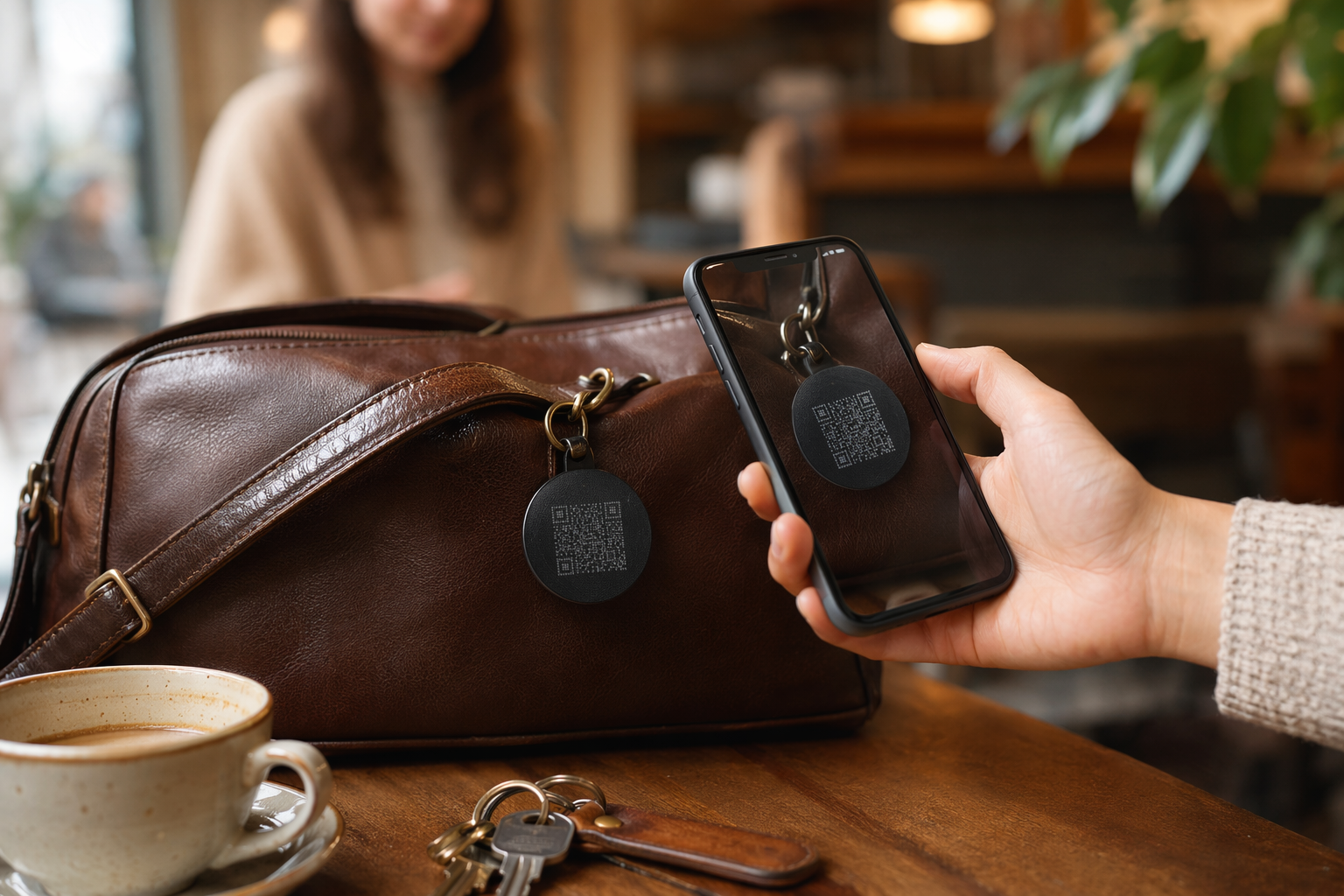
Imagine a neighbour finds your child walking alone. They do not know your family. They cannot get the child to speak. What do they do? If your child is wearing a QR tag, the answer is simple: they open their phone camera, point it at the tag, and in seconds they are looking at your child's name, your phone number, a photo, and any key information you have chosen to share. No app to download. No account needed. Just a scan.
This is exactly what a Tagback QR tag is built for. You set up a profile with your child's photo, first name, your contact number, and anything a finder needs to know — such as "Our child is non-verbal and may seem frightened of strangers. Please stay calm and call this number immediately." The tag itself is a durable, waterproof disc or sticker that can go on a silicone bracelet, a school bag, a jacket zip, or a shoe. When someone scans it, they reach the profile instantly — and you receive a notification telling you the tag was scanned and showing you the approximate location.
For autistic children who elope in unfamiliar areas, this combination — a finder who can act immediately and a parent who is notified the moment the tag is scanned — is extraordinarily powerful.
What Information to Include on Your Child's ID
Getting the right information onto a tag is a balance between privacy and usefulness. Here is a practical framework:
- First name only. Full surnames on a public-facing tag create a small but real risk of a stranger using the name to approach your child in other situations. First name is enough for a finder to address your child and feel connected.
- Your mobile number — the one you will always have with you. Add a second number (partner, grandparent, school) if space allows.
- A brief behavioural note. "May not respond to their name" or "non-verbal" tells a finder not to give up if the child seems to be ignoring them. This one line can prevent a well-meaning person from walking away.
- A photo. On a QR tag profile, a clear recent photo is one of the most useful things you can provide. It lets police, paramedics, and members of the public confirm they have the right child when there are no words.
- Medical essentials only. If your child has epilepsy, a severe allergy, or takes medication that affects how they should be handled in an emergency, include it. Not every diagnosis needs to be listed.
- Condition name, if helpful. Many parents include the word AUTISM because it immediately tells a first responder to expect possible communication differences and to use a calm, patient approach.
Helping Your Child Get Comfortable Wearing the Tag
Even the best ID tag fails if it ends up in a drawer because your child refuses to wear it. Building tolerance takes time and patience — but it is achievable for most children.
- Start short. Introduce the bracelet or tag for just a few minutes during a calm, enjoyable activity. Keep sessions positive and brief. Gradually extend the time over days and weeks.
- Let them choose. If your child can engage with the choice, let them pick the colour of a silicone band, the design of a tag, or where on their body it goes. Ownership reduces resistance.
- Pair it with something good. Put the bracelet on at the start of a preferred activity — a favourite show, a special snack. The tag becomes associated with something pleasant rather than with a struggle.
- Be consistent. Put it on at the same point in the morning routine every day. Predictability is reassuring for most autistic children, and a routine reduces the tag becoming a focus of anxiety.
- Praise and ignore. Notice and praise every moment your child tolerates the tag. Do not draw attention to moments when they touch or fidget with it — attending to that behaviour can reinforce it.
Register with Local First Responders Before You Need Them
An ID tag gets your child home. A registry means police and paramedics know who your child is before they are even missing.
- Safe Return programs. Many police departments and autism organisations run voluntary registries where families submit a photo, description, and home address. Officers responding to a report of a child found alone can check the registry immediately.
- National autism organisations. In the US, the Autism Society of America and the National Center for Missing & Exploited Children both have resources for families. In the UK, the National Autistic Society can help connect families with local schemes.
- School and respite care providers. Make sure every setting your child attends has an up-to-date emergency contact list, a recent photo, a description of how your child communicates, and a written elopement protocol.
- Notify neighbours. A simple note or conversation with nearby neighbours — "our child sometimes leaves the house unexpectedly, please call us if you see them alone" — has reunited many families faster than any official system.
- Practice with your child what to do. If your child has any ability to understand, practise saying or showing their tag to a trusted adult. Even a partially verbal child can be taught to hold out their wrist to show a tag.
No single solution is perfect for every child. The families who feel most prepared tend to layer their approach: a sensory-friendly bracelet as the primary ID, shoe labels as a backup, a QR tag for detailed information, and a local registry so first responders already know their child. Start with one step today. Even one reliable form of ID on your child's body is an enormous leap forward.
FAQ
What is the best ID tag for an autistic child who removes wristbands?+
For children who remove wristbands, shoe labels inside the shoe are the most reliable backup — they are hidden from the child's view and difficult to reach. Iron-on clothing labels in every item of clothing are a second layer. A QR sticker tag on a school bag or jacket zip is also worth adding, since bags are often found with a child even if the bracelet is gone. Temporary tattoo-style ID stickers (such as SafetyTat) are a good option for high-risk days like travel or outings.
Should I put my child's full name and address on their autism ID tag?+
Most safety experts recommend using first name only on any publicly visible tag, rather than a full name or home address. A first name and parent mobile number is sufficient for a finder to reunite you. Including a full address creates a small privacy risk if the tag is seen in other contexts. A QR tag lets you share more detailed information securely — only someone who physically scans the tag sees the profile, and you receive a notification when it is scanned.
Do GPS trackers replace ID tags for autistic children?+
GPS trackers and ID tags serve different purposes and work best together. A GPS device tells you where your child is in real time, which dramatically cuts search time. But GPS requires a charged battery and a cellular signal — if either fails, you lose tracking. An ID tag requires no power and works for anyone who finds your child, including a member of the public who has no access to your tracker app. Always use a passive ID (bracelet, shoe label, or QR tag) as a backup to any GPS device.
What does a QR ID tag for autism show when someone scans it?+
When a stranger scans a Tagback QR tag, they are taken instantly to a profile page showing whatever information you have chosen to include — typically your child's first name, your contact number, a photo, and any key notes (such as 'non-verbal' or 'please stay calm and call this number'). The finder does not need to download an app or create an account. At the same moment, you receive a notification that the tag was scanned, along with an approximate location, so you know help is on the way.
Start protecting what matters
Tagback is free, forever. No subscription. No app needed for finders.
Create your free tag