
Dog License and Registration: What's Required, What It Costs, and Why It Matters
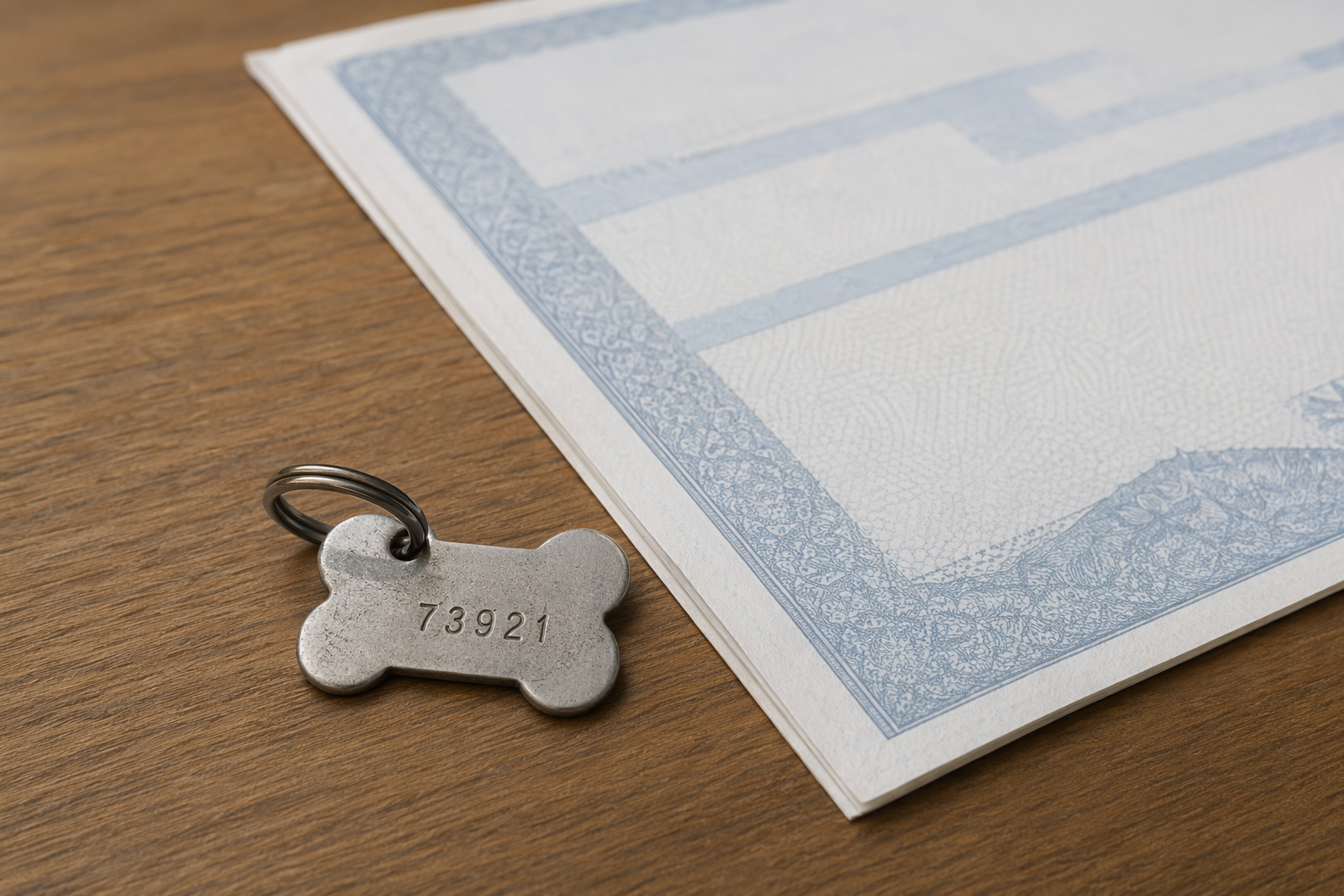
Most dog owners know they're supposed to register their dog. Far fewer know what registration actually accomplishes, why the license tag matters beyond the fine, or that microchipping — which most owners get done — involves a second step that the majority skip entirely. This guide covers the full picture: what registration is, what it costs, what the physical license tag does in a shelter context, and how to build the three-layer ID system that gives your dog the best odds of coming home.
What a dog license actually is (and what happens if you skip it)
Dog licensing in the United States is governed at the county or municipal level, not federally. There is no national dog registration — the rules are set by your city or county, and they vary. The same is broadly true in Australia, where each local council administers its own scheme. The UK takes a different approach: there is no licensing system in the same sense, but microchipping is a national legal requirement.
In US jurisdictions that require it — which is most of them — a dog license serves three purposes:
- Rabies tracking. Licensing is tied to proof of rabies vaccination, giving local health authorities a record of which dogs in the community are vaccinated. This matters in the event of a bite incident or a regional rabies outbreak.
- Stray return infrastructure. When animal control picks up a dog, the license number on the tag links directly to the owner's contact information in the local database — far faster than scanning a microchip and searching national registries.
- Funding animal services. License fees fund your local shelter, animal control officers, and stray-animal response. The $15 renewal fee goes back into the system that returns lost dogs.
What happens if you skip it? Fines for unlicensed dogs in the US typically run $50 to $500 depending on jurisdiction and whether it is a first or repeat offense. In many counties, an unlicensed dog picked up by animal control will not be released until the owner pays both the impound fees and applies for the license. The practical cost of skipping a $15 annual license can easily exceed $300 in a single incident.
What you typically need to register your dog
Requirements vary by location, but the core documents are consistent across most US counties:
- Proof of current rabies vaccination. This is the non-negotiable item. You will need a certificate from your vet showing the vaccine was administered and when it expires. A 1-year or 3-year rabies vaccine will determine your renewal schedule.
- Proof of spay or neuter (if applicable). Most counties charge a reduced license fee — sometimes half — for sterilized dogs. Bring documentation from your vet confirming the procedure.
- Microchip number. An increasing number of jurisdictions now require microchip information as part of the registration record. Even where it is not required, providing the chip number links two identification systems in the county database.
- Payment. Fees typically range from $10 to $25 per year for spayed or neutered dogs, and $25 to $50 or more for intact animals. Some counties offer multi-year registration if your dog is on a 3-year rabies vaccine cycle.
In Australia, registration requirements are similar in structure: proof of vaccination, microchip compliance (mandatory in all states by 12 weeks of age), and a fee to the local council. In the UK, there is no equivalent licensing system — but microchipping all dogs by eight weeks of age is a legal requirement under the Microchipping of Dogs (England) Regulations 2015, with a £500 fine for non-compliance.
How to register: local, online, and what to bring
In the US, registration is handled through your local county animal control or animal services office. Most counties now offer three ways to register:
- Online. Search "[your county name] dog license" to find your county's animal services portal. Online registration typically provides instant confirmation and mails the license tag within a few days.
- In person. Visit the animal control office or any participating vet clinic. Bring your rabies certificate, spay/neuter documentation, and payment. The tag is usually issued on the spot.
- By mail. Some counties still support paper applications. Download the form from the county website, attach copies of your documentation, and mail with a check. Allow 2–3 weeks for the tag to arrive.
Once registered, attach the tag to your dog's collar immediately. It is not a keepsake — it is a working piece of identification that belongs on the collar at all times, not in a drawer. Set a calendar reminder 30 days before your renewal date, and tie renewal to your dog's annual vet appointment to ensure you always have current vaccination paperwork.
The dog license tag and shelter reunification
The physical license tag is the fastest reunification tool in the shelter system — faster than a microchip in most cases. Here is why.
When animal control brings in a dog, shelter staff look at the collar first. A license tag number can be looked up in the county database in under a minute. That lookup returns the owner's name, address, and phone number. The owner gets a call before the dog even enters the formal hold period.
Without a tag, the process slows significantly:
- The dog is scanned for a microchip. If the scanner is universal and the chip is registered, this may work — but it requires the chip to be registered (see the next section).
- If the chip lookup returns nothing, the dog enters the stray hold: a legally required wait period of 3 to 5 business days depending on jurisdiction.
- During the hold, the shelter may post photos online. Most owners never think to check shelter listings because they assume someone would have called.
- After the hold period expires, unclaimed dogs can be transferred to adoption, rescue, or in high-intake shelters, euthanized. This is not a worst-case scenario — it is routine in underfunded municipal shelters.
A current license tag on the collar compresses all of that to a single phone call. It is the simplest, most reliable piece of ID your dog carries — and it costs less than a coffee to maintain each year.
Microchip registration — the step most people skip
A microchip implant and microchip registration are two completely different things. The chip is hardware — a passive RFID device the size of a grain of rice, implanted under the skin between the shoulder blades. The chip contains only a number. On its own, that number links to nothing.
Registration is the separate step — done online, not at the vet — that links the chip number to your contact details in a searchable database. Studies suggest fewer than half of microchipped pets are actually registered. The typical failure sequence:
- Owner pays for the implant at the vet (~$45–$70 as a one-time fee).
- Vet hands over a card with the chip number and mentions registering it.
- Owner sets the card aside and means to do it later.
- The chip exists in the dog. No entry exists in any registry.
- If the dog is found and scanned, the chip number returns nothing.
The major US registries where you can register or verify registration: AKC Reunite (akcreunite.org), HomeAgain (homeagain.com), PetLink (petlink.net), and Petco Lost & Found / Found Animals (foundanimals.org — free lifetime registration). The AAHA Universal Lookup at petmicrochiplookup.org searches all major databases simultaneously — use it right now to verify your dog's chip is actually registered.
In the UK, chips must be registered on a Defra-compliant database (Petlog, MicroChipCentral, etc.) — the vet who implants the chip is legally required to register it, but you are responsible for keeping your contact details current. In Australia, each state has its own registry (NSW Pet Registry, Victorian Pets Register, etc.) — check your state's council or agricultural department for the correct database.
The complete three-layer ID system
No single form of identification is sufficient on its own. Each layer covers a different failure mode:
- License tag. The first thing a shelter scans. Legally required in most US jurisdictions and Australian councils. Tied to a county database that staff can look up immediately. Renew annually. Costs $10–$25/year.
- Microchip. Permanent and tamper-proof. Survives collar loss. Required by law in the UK and Australia, and in growing parts of the US. Only useful if registered — verify yours at petmicrochiplookup.org.
- QR tag (Tagback). Works in the first minutes after a dog is found — before any vet or shelter is involved. Anyone with a smartphone scans the tag and immediately sees your contact details, emergency contacts, medical notes, and anything else you add to your dog's profile. Free, no subscription, no limits.
Consider the realistic scenario: a neighbour finds your dog in the street at 8pm on a Sunday. No animal control pickup is happening tonight. The neighbour has no idea where to take the dog. A QR tag means they scan it with their phone camera and are connected to you within 30 seconds. The license tag and microchip are essential — but they depend on the finder taking the dog somewhere official. The QR tag works wherever the finder is standing.
The three layers together cover every realistic lost-dog scenario: the finder who calls animal control, the shelter that scans for chips, and the neighbour who just wants to return a dog to its owner tonight.
FAQ
Is dog licensing required everywhere in the US?+
Requirements vary by municipality. Most US cities and counties require a license; some rural areas do not. Check with your local animal control or city/county website. Fines for unlicensed dogs range from $50 to $500 depending on location.
Do I need to renew my dog's license every year?+
Most jurisdictions require annual renewal — tied to annual rabies booster requirements. Some offer multi-year licenses if your dog is up to date on a 3-year rabies vaccine. Keep the renewal receipt and the license tag current.
What happens if my dog is picked up without a license tag?+
Without a tag, shelter staff have no easy way to identify your dog's owner. The dog enters the stray system: a required hold period (typically 3–5 days) before it can be adopted out or euthanized. With a tag, most shelters call before the hold period begins.
My dog has a microchip — do I still need to register it?+
Yes. The microchip implant is just the hardware. You must register your contact details with a microchip registry (AKC Reunite, HomeAgain, PetLink, Petco Lost & Found) for the chip to lead back to you. A chip without registration is nearly useless.
Start protecting what matters
Tagback is free, forever. No subscription. No app needed for finders.
Create your free tag