
Flying with a Dog or Cat: The Complete 2026 Airline Pet Guide
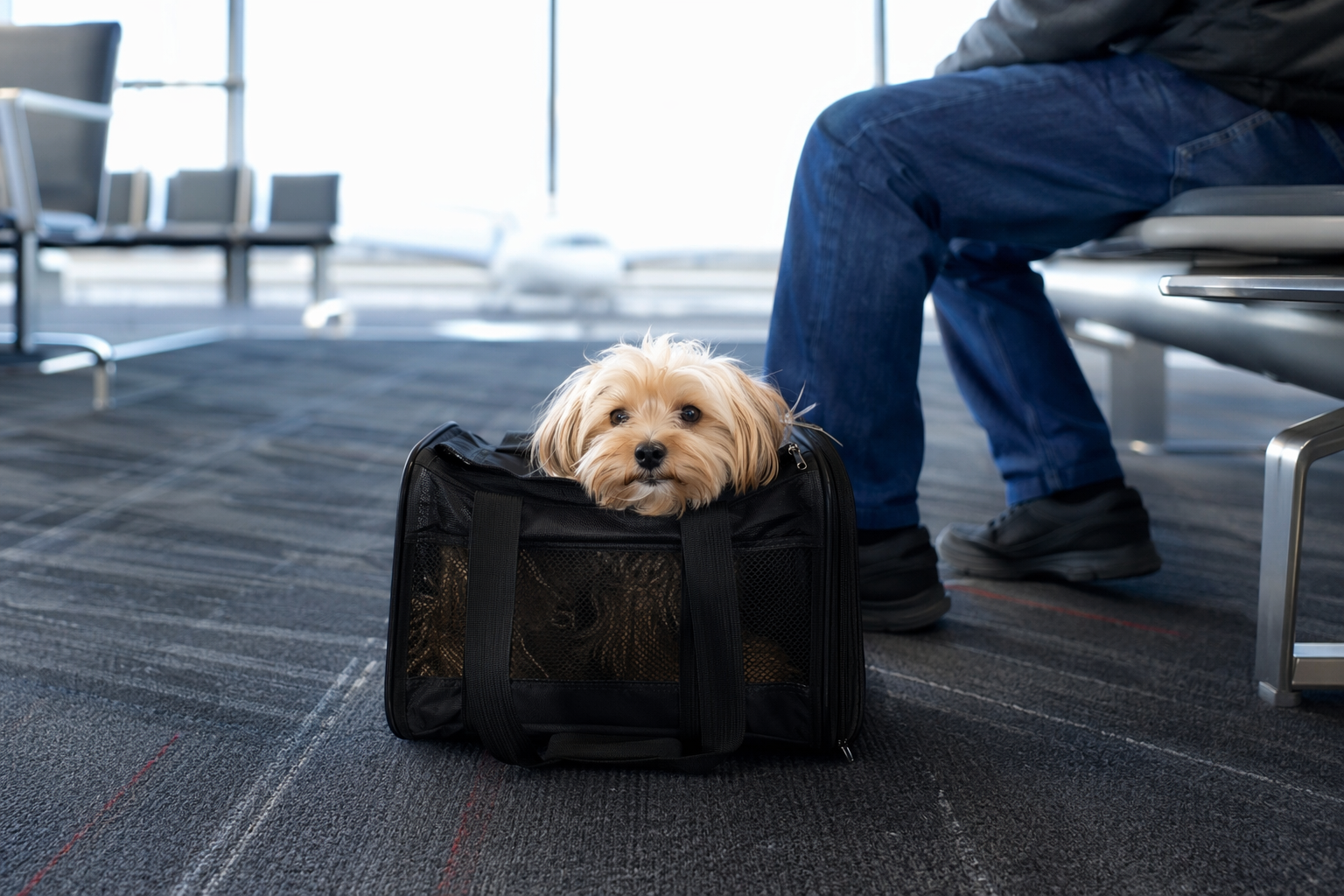
Airlines have specific rules for traveling with pets, and they vary dramatically by carrier — sometimes even by route or aircraft type. Whether you're wondering "can I bring my cat on a plane?" or planning your first trip flying with a dog, the stakes are high enough that you want to get this right before you book. This guide covers everything: cabin vs cargo, airline policies, breed bans, required vet documents, carrier specs, and what to do at the airport to keep your pet safe.
In-Cabin vs Cargo vs Checked Pet: Which Option Applies to You?
There are three ways a pet can travel on a commercial flight. Understanding the difference — and which one your pet qualifies for — is the most important decision you'll make.
- In-cabin. Your pet travels with you in the passenger cabin, inside a soft-sided carrier stored under the seat in front of you. This is only available for small pets — typically dogs and cats under 15–20 lbs combined with their carrier. It is by far the safest option and the one most pet owners prefer.
- Checked baggage (as excess baggage). Available on some carriers for larger dogs traveling in an airline-approved hard crate in the pressurized, temperature-controlled hold. The pet is checked at the ticket counter and reunited with you at baggage claim. Not all airlines still offer this — United and American do; Delta eliminated it for most routes.
- Cargo (manifest cargo / pet-in-hold). For very large dogs or certain breeds, your pet travels as air cargo on the same or a separate flight. This is handled through the airline's cargo division, has different booking processes and costs, and carries more logistical risk than the other two options. Reserve this only when no other choice exists.
If your pet qualifies for in-cabin travel, always choose it. The cargo hold — while pressurized and temperature-controlled on modern aircraft — exposes your pet to more stress, noise, and handling than the cabin. In-cabin keeps you together and lets you monitor your pet throughout the flight.
Which Airlines Allow In-Cabin Pets in 2026
Policies change frequently, so always confirm directly with the airline before booking. That said, here is how the major US carriers stand as of 2026 for traveling with pets on domestic flights:
- American Airlines — Allows in-cabin pets (dogs, cats, household birds) on most domestic routes. Fee: $150 each way. Weight limit: pet + carrier combined must not exceed the under-seat space. Carrier dimensions: maximum 19" × 13" × 9" soft-sided.
- Delta Air Lines — Allows cats and dogs in-cabin on domestic US flights. Fee: $150 each way. No checked pet service for most routes. Delta has strict size enforcement — bring a measuring tape.
- United Airlines — Allows cats and dogs in-cabin. Fee: $150 each way. United also offers PetSafe, its cargo program for larger pets, with separate booking. Carrier max: 17.5" × 12" × 7.5".
- Southwest Airlines — Allows cats and dogs in-cabin on domestic flights. Fee: $125 each way, one of the lower rates. No international service.
- JetBlue — Allows cats and dogs in-cabin via its JetPaws program. Fee: $125 each way. Allows up to 4 pets per flight, so spots are not as limited as on some other carriers.
- Alaska Airlines — Allows cats and dogs in-cabin on most routes. Fee: $100 each way. Also accepts checked pets on certain routes.
A few practical notes that apply across carriers: most airlines limit the number of pets per flight (often 4–6 in-cabin slots total), pets must be booked directly with the airline and cannot be added through third-party booking sites, and fees are one-way and non-refundable even if your flight is canceled.
Breed Restrictions: Brachycephalic Dogs and Cats
If you have a flat-faced (brachycephalic) breed, read this section carefully. The shortened nasal passages in these breeds make breathing more difficult under normal conditions — and significantly more dangerous under the stress and reduced air pressure of flying.
Commonly restricted dog breeds include Bulldogs (English, French, and American), Pugs, Boston Terriers, Shih Tzus, Boxers, Mastiffs, and Pekingese. Restricted cat breeds include Persians, Himalayans, and Burmese.
American Airlines, Delta, and United all ban most brachycephalic breeds from cargo and checked pet travel. Some carriers extend restrictions to in-cabin travel as well, particularly in warm weather months. Policies differ — Delta has a more comprehensive breed ban list than United, for example.
If you have a restricted breed, your options are: drive instead of fly, use a specialist pet relocation service that uses chartered or cargo-converted aircraft, or consult your vet about whether your individual animal is healthy enough to fly and which carrier has the most permissive current policy. Never attempt to misrepresent your pet's breed — airlines do check at the counter.
Required Documents for Flying with a Pet
Airlines and governments require specific documentation for pet travel. Missing a single document can mean your pet cannot board — or, in international travel, faces quarantine. Prepare these well in advance.
- Health certificate (Certificate of Veterinary Inspection). Required by most airlines and by law for interstate and international travel. Must be issued by a licensed veterinarian and is typically valid for only 10 days from the date of examination. Schedule your vet appointment accordingly — not weeks in advance.
- Vaccination records. Rabies vaccination records are required for most destinations and many airlines. Have the original certificate with the vet's signature and your pet's identifying information. Some airlines also require distemper and Bordetella records for dogs.
- Airline-specific forms. Some carriers require you to sign an acclimation certificate (confirming your pet can handle the temperature range at origin and destination) or a live animal checklist. Download these from the airline's website and complete them before arriving at the airport.
- USDA endorsement for international travel. If you are traveling internationally, the health certificate must be endorsed by a USDA-accredited veterinarian and then officially endorsed by your regional USDA APHIS Veterinary Services office. This process can take 3–10 business days. Plan accordingly — ideally 3–4 weeks before departure.
Keep all documents in a dedicated travel folder or waterproof pouch that stays with you (not in checked luggage). If documents are lost or unavailable at check-in, you may be denied boarding for your pet.
Choosing the Right Pet Carrier or Crate
Your carrier is not just a bag — it is the environment your pet will live in for the duration of travel. Getting this right matters for your pet's comfort and for airline compliance.
- For in-cabin travel, you need a soft-sided carrier that fits under the seat in front of you. The typical under-seat space is roughly 18" × 11" × 11", but this varies by aircraft and even by seat row. Check your specific airline's carrier dimension requirements — they differ.
- For cargo or checked pet travel, you need a hard-sided crate meeting IATA Live Animals Regulations standards. The crate must be large enough for your pet to stand, turn around, and lie down comfortably. It must have ventilation on at least three sides, a secure latch (not just zip ties), food and water dishes accessible from outside, and "Live Animal" labels on the top and sides.
- Acclimate your pet to the carrier well before travel. Leave it out at home with the door open, place familiar bedding inside, and feed your pet near it. A pet that panics in the carrier on travel day has likely never spent meaningful time in it.
- Soft vs hard for cabin: Airlines require soft-sided for in-cabin travel because they need to compress slightly to fit under the seat. Brands like Sherpa, Sleepypod, and Petmate are popular and airline-approved, but always verify current dimensions against your airline's current spec before purchasing.
At the Airport: What to Expect
Arrive earlier than you normally would. Most airlines recommend arriving at least 30 minutes earlier than your standard buffer when traveling with pets — there is additional paperwork at check-in, and if your documents are not in order, you need time to resolve issues.
- Check in at the ticket counter, not a kiosk. You cannot check in a pet via self-service. An agent will verify your carrier dimensions, inspect your health certificate, and collect the pet fee. Have everything organized before you approach the counter.
- Security. You will need to remove your pet from the carrier at the security checkpoint. The carrier goes through the X-ray machine; your pet goes through the metal detector with you. Hold your pet securely — this is a high-stress moment and pets can bolt. A leash or harness under the carrier is strongly recommended.
- At the gate. Keep your pet in the carrier. Let your pet settle rather than taking them out repeatedly. If your pet needs a bathroom break, find a designated pet relief area before reaching the gate — these are typically before security in most major airports. Once past security, options are limited.
- Limited spots fill up. On popular routes and holidays, in-cabin pet spots sell out. Book as far in advance as possible. If you are booking a last-minute flight, call the airline directly to confirm a spot is available before purchasing.
During the Flight: Keeping Your Pet Calm
Most pets adjust to the flight better than their owners expect, especially if they are in-cabin and can smell and hear you nearby. A few things that make a meaningful difference:
- Do not sedate your pet. The American Veterinary Medical Association (AVMA) advises against sedating pets for air travel. Sedation can affect a pet's balance and muscle coordination, which are important for staying stable in a crate. At altitude, sedatives can also affect respiratory and cardiovascular function in unpredictable ways.
- Offer water at the gate and after landing. Most pets will not drink during the flight itself, but hydration before and after matters. For longer flights, a water-dispensing attachment on the carrier or frozen water in a bowl (which melts slowly) can help.
- Familiar items reduce anxiety. A small piece of clothing with your scent, their usual blanket or a familiar toy placed in the carrier can help regulate anxiety.
- Keep your voice calm and low. Pets take cues from you. Speaking quietly and calmly is more effective than constant reassurance, which can signal to your pet that something is wrong.
- Calming aids without sedation. Products like Adaptil (dog-appeasing pheromone) or Feliway (for cats) are available as sprays you can apply to the carrier bedding before travel. Some veterinarians recommend calming supplements like L-theanine. Discuss options with your vet well before your travel date.
Pet ID for Travel: What Happens If Your Pet Gets Loose
Airports are high-risk environments for pet escapes. The security checkpoint — where you remove your pet from the carrier — is the most common moment. But escapes also happen at baggage claim, in terminal corridors, and at destination airports in unfamiliar cities. A lost pet in a busy airport or an unfamiliar city is a genuine emergency, and the difference between recovery and loss often comes down to identification.
- Microchip. The baseline. Every pet that travels should be microchipped and registered with current contact information. Confirm your registration is active and your phone number is correct before every trip.
- QR collar tag. A microchip requires a scanner. A QR tag can be scanned by anyone with a smartphone — a gate agent, a fellow passenger, airport staff — instantly displaying your contact information and your pet's profile without any special equipment.
- Tagback Lost Mode. Before you board, activate Lost Mode on your pet's Tagback profile. Lost Mode puts your pet's finder page on high alert: anyone who scans the QR tag sees a clear "This pet is lost" message, your contact details, and a way to reach you immediately. You receive a scan notification the moment anyone scans the tag — even if you are mid-flight and cannot respond right away, you will know the moment your pet is found.
- Multilingual finder pages. If you are traveling internationally, Tagback's finder pages are available in both English and Spanish, which is useful across Latin America and in many US airports. The person who finds your pet does not need to speak your language to get the right information.
- The habit to build: Activate Lost Mode before you reach the security checkpoint — not after something goes wrong.
International Pet Travel: Additional Requirements
Domestic flights are complex enough. International travel with pets adds a layer of country-specific regulations that can take weeks to prepare correctly. Start researching at least 2–3 months before your trip.
- EU pet passport. If you are traveling to the European Union, your pet needs an EU-format pet passport issued by an authorized vet, showing microchip number, rabies vaccination date, and owner details. US-issued health certificates are not the same document.
- Rabies titer test. Some countries (Japan, Australia, New Zealand, Hawaii, Finland, Malta, and others) require a rabies antibody titer test showing your pet has sufficient immunity. The test must be done at an approved laboratory, and many countries then require a waiting period of 90–180 days after a satisfactory result before entry is permitted. This is the timeline that catches most travelers off guard.
- Quarantine countries. Australia, New Zealand, Hawaii (as a US state with unique disease-free status), and the United Kingdom have mandatory quarantine or very strict pre-arrival requirements. Australia and New Zealand require quarantine stays of up to 10 days at approved facilities, at the owner's expense. Do not underestimate the planning and cost involved.
- USDA APHIS endorsement. For most international destinations, your US health certificate must be endorsed by the USDA. Use the USDA APHIS website to find your regional office and confirm current processing times — they fluctuate, and peak travel seasons can create delays.
- Destination country import permits. Some countries require a formal import permit obtained before travel. Check the requirements for your specific destination through both the destination country's agriculture or customs authority and the US embassy or USDA APHIS country page.
For international travel, consider hiring a professional pet relocation service for your first trip. They are familiar with current requirements for specific routes, have relationships with veterinary offices experienced in USDA paperwork, and can flag issues before they become problems at the border.
FAQ
Can I bring my dog in the cabin on a plane?+
Yes, if your dog is small enough. Most airlines require the dog and carrier combined to fit under the seat in front of you — typically under 15–20 lbs total. You will pay a fee of $100–$150 each way and must book the pet spot directly with the airline. Brachycephalic breeds (Bulldogs, Pugs, French Bulldogs) are restricted or banned on many carriers even for in-cabin travel.
What if my dog is too big to fly in the cabin?+
Dogs that exceed in-cabin size and weight limits can travel as checked baggage (in the pressurized hold) or as cargo, depending on the airline. American and United still offer checked pet service on many domestic routes; Delta has largely eliminated it. Very large breeds often must use the airline's cargo program or a dedicated pet shipping service. In all cases, a USDA-endorsed health certificate and an IATA-compliant hard crate are required.
Do pets need a health certificate to fly?+
Yes. A health certificate issued by a licensed veterinarian is required by most airlines and by federal law for pets traveling across state lines or internationally. It is typically valid for only 10 days from the date of examination, so schedule your vet appointment close to your departure date. For international travel, the certificate must also be endorsed by the USDA APHIS — a process that can take several business days.
Which airline is most pet-friendly in 2026?+
JetBlue and Alaska Airlines are frequently rated among the most pet-friendly for in-cabin travel, with fees starting at $100–$125 each way and relatively straightforward policies. Southwest is also popular for its $125 fee and consistent domestic pet acceptance. For larger dogs requiring cargo travel, United's PetSafe program is one of the more established options. Always verify current policies directly with the airline before booking, as rules change.
Start protecting what matters
Tagback is free, forever. No subscription. No app needed for finders.
Create your free tag