
Viajar en Avión con un Perro o Gato: La Guía Completa de Aerolíneas 2026
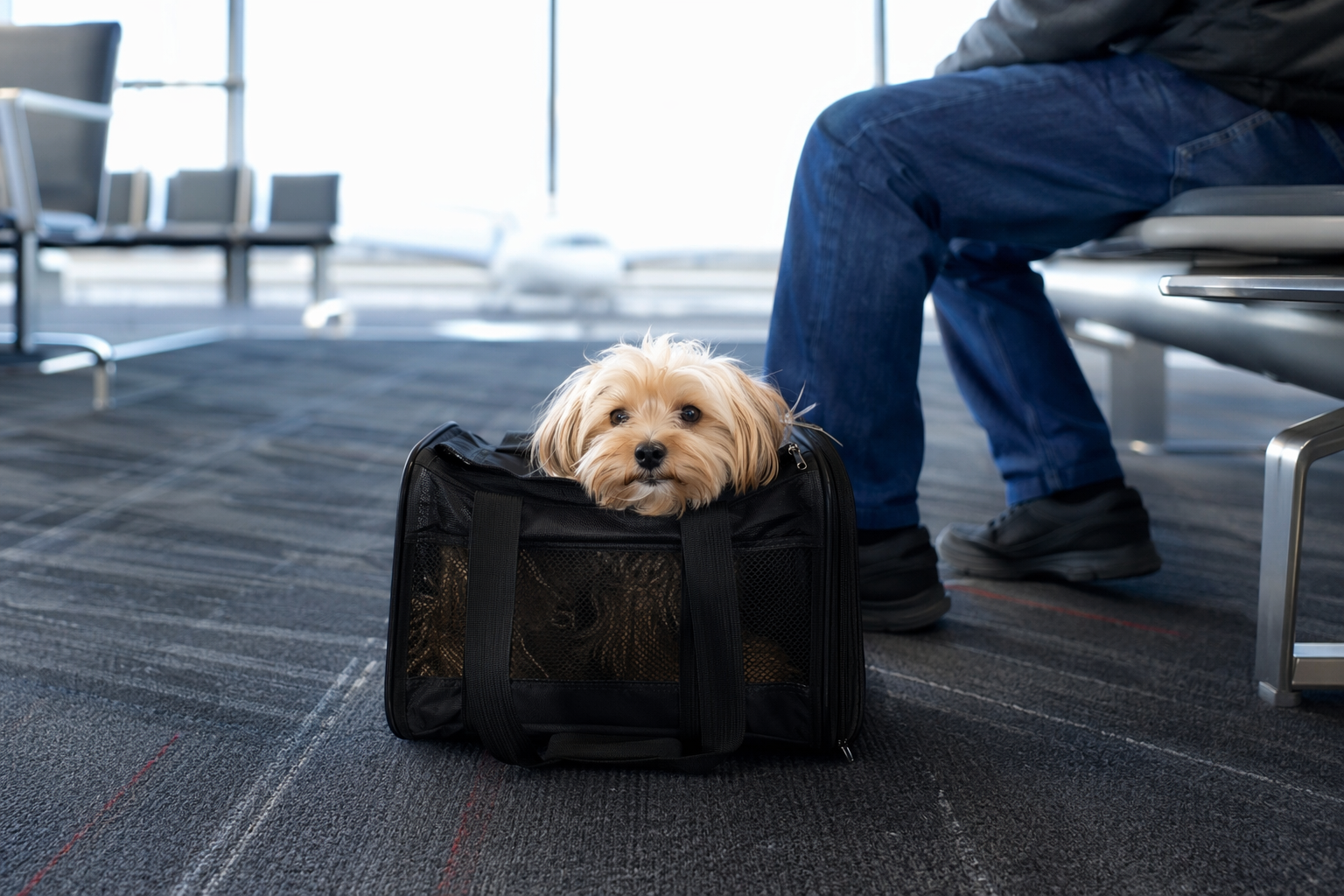
Las aerolíneas tienen reglas específicas para viajar con mascotas, y varían drásticamente según la compañía — a veces incluso según la ruta o el tipo de aeronave. Ya sea que te preguntes "¿puedo llevar a mi gato en el avión?" o estés planeando tu primer viaje volando con un perro, lo que está en juego es lo suficientemente importante como para que lo hagas bien antes de reservar. Esta guía cubre todo: cabina vs bodega, políticas de aerolíneas, prohibiciones de razas, documentos veterinarios requeridos, especificaciones de transportadoras y qué hacer en el aeropuerto para mantener a tu mascota segura.
Cabina vs Bodega vs Mascota Documentada: ¿Qué Opción se Aplica a Ti?
Hay tres formas en que una mascota puede viajar en un vuelo comercial. Entender la diferencia — y para cuál califica tu mascota — es la decisión más importante que tomarás.
- In-cabin. Your pet travels with you in the passenger cabin, inside a soft-sided carrier stored under the seat in front of you. This is only available for small pets — typically dogs and cats under 15–20 lbs combined with their carrier. It is by far the safest option and the one most pet owners prefer.
- Checked baggage (as excess baggage). Available on some carriers for larger dogs traveling in an airline-approved hard crate in the pressurized, temperature-controlled hold. The pet is checked at the ticket counter and reunited with you at baggage claim. Not all airlines still offer this — United and American do; Delta eliminated it for most routes.
- Cargo (manifest cargo / pet-in-hold). For very large dogs or certain breeds, your pet travels as air cargo on the same or a separate flight. This is handled through the airline's cargo division, has different booking processes and costs, and carries more logistical risk than the other two options. Reserve this only when no other choice exists.
Si tu mascota califica para viajar en cabina, elige siempre esa opción. La bodega de carga — aunque está presurizada y con temperatura controlada en aeronaves modernas — expone a tu mascota a más estrés, ruido y manipulación que la cabina. Viajar en cabina te mantiene juntos y te permite monitorear a tu mascota durante todo el vuelo.
Qué Aerolíneas Permiten Mascotas en Cabina en 2026
Las políticas cambian frecuentemente, así que siempre confirma directamente con la aerolínea antes de reservar. Dicho esto, así es como están las principales aerolíneas estadounidenses a partir de 2026 para viajar con mascotas en vuelos domésticos:
- American Airlines — Allows in-cabin pets (dogs, cats, household birds) on most domestic routes. Fee: $150 each way. Weight limit: pet + carrier combined must not exceed the under-seat space. Carrier dimensions: maximum 19" × 13" × 9" soft-sided.
- Delta Air Lines — Allows cats and dogs in-cabin on domestic US flights. Fee: $150 each way. No checked pet service for most routes. Delta has strict size enforcement — bring a measuring tape.
- United Airlines — Allows cats and dogs in-cabin. Fee: $150 each way. United also offers PetSafe, its cargo program for larger pets, with separate booking. Carrier max: 17.5" × 12" × 7.5".
- Southwest Airlines — Allows cats and dogs in-cabin on domestic flights. Fee: $125 each way, one of the lower rates. No international service.
- JetBlue — Allows cats and dogs in-cabin via its JetPaws program. Fee: $125 each way. Allows up to 4 pets per flight, so spots are not as limited as on some other carriers.
- Alaska Airlines — Allows cats and dogs in-cabin on most routes. Fee: $100 each way. Also accepts checked pets on certain routes.
Algunas notas prácticas que aplican para todas las aerolíneas: la mayoría limita el número de mascotas por vuelo (a menudo 4–6 espacios en cabina en total), las mascotas deben reservarse directamente con la aerolínea y no pueden agregarse a través de sitios de reserva de terceros, y las tarifas son de ida y no reembolsables incluso si tu vuelo es cancelado.
Restricciones de Razas: Perros y Gatos Braquicéfalos
Si tienes una raza de cara chata (braquicefálica), lee esta sección cuidadosamente. Los conductos nasales acortados en estas razas hacen que la respiración sea más difícil bajo condiciones normales — y significativamente más peligrosa bajo el estrés y la presión de aire reducida al volar.
Razas de perros comúnmente restringidas incluyen Bulldogs (Inglés, Francés y Americano), Pugs, Boston Terriers, Shih Tzus, Boxers, Mastiffs y Pekingese. Razas de gatos restringidas incluyen Persas, Himalayos y Burmeses.
American Airlines, Delta y United prohíben la mayoría de las razas braquicefálicas de viajar en bodega y como mascota documentada. Algunas aerolíneas extienden las restricciones también a viajes en cabina, particularmente en los meses cálidos. Las políticas difieren — Delta tiene una lista de prohibición de razas más completa que United, por ejemplo.
Si tienes una raza restringida, tus opciones son: conducir en lugar de volar, usar un servicio especializado de reubicación de mascotas que utilice aviones chárter o convertidos para carga, o consultar con tu veterinario si tu animal individual está lo suficientemente saludable para volar y qué aerolínea tiene la política actual más permisiva. Nunca intentes tergiversar la raza de tu mascota — las aerolíneas sí verifican en el mostrador.
Documentos Requeridos para Volar con una Mascota
Las aerolíneas y gobiernos requieren documentación específica para el viaje de mascotas. Faltar un solo documento puede significar que tu mascota no pueda abordar — o, en viajes internacionales, enfrentar cuarentena. Prepara estos con bastante anticipación.
- Health certificate (Certificate of Veterinary Inspection). Required by most airlines and by law for interstate and international travel. Must be issued by a licensed veterinarian and is typically valid for only 10 days from the date of examination. Schedule your vet appointment accordingly — not weeks in advance.
- Vaccination records. Rabies vaccination records are required for most destinations and many airlines. Have the original certificate with the vet's signature and your pet's identifying information. Some airlines also require distemper and Bordetella records for dogs.
- Airline-specific forms. Some carriers require you to sign an acclimation certificate (confirming your pet can handle the temperature range at origin and destination) or a live animal checklist. Download these from the airline's website and complete them before arriving at the airport.
- USDA endorsement for international travel. If you are traveling internationally, the health certificate must be endorsed by a USDA-accredited veterinarian and then officially endorsed by your regional USDA APHIS Veterinary Services office. This process can take 3–10 business days. Plan accordingly — ideally 3–4 weeks before departure.
Mantén todos los documentos en una carpeta de viaje dedicada o bolsa impermeable que esté contigo (no en equipaje documentado). Si los documentos se pierden o no están disponibles en el check-in, pueden negarte el abordaje para tu mascota.
Elegir la Transportadora o Jaula Correcta para Mascotas
Tu transportadora no es solo una bolsa — es el ambiente en el que tu mascota vivirá durante todo el viaje. Hacerlo bien importa para la comodidad de tu mascota y para cumplir con la aerolínea.
- For in-cabin travel, you need a soft-sided carrier that fits under the seat in front of you. The typical under-seat space is roughly 18" × 11" × 11", but this varies by aircraft and even by seat row. Check your specific airline's carrier dimension requirements — they differ.
- For cargo or checked pet travel, you need a hard-sided crate meeting IATA Live Animals Regulations standards. The crate must be large enough for your pet to stand, turn around, and lie down comfortably. It must have ventilation on at least three sides, a secure latch (not just zip ties), food and water dishes accessible from outside, and "Live Animal" labels on the top and sides.
- Acclimate your pet to the carrier well before travel. Leave it out at home with the door open, place familiar bedding inside, and feed your pet near it. A pet that panics in the carrier on travel day has likely never spent meaningful time in it.
- Soft vs hard for cabin: Airlines require soft-sided for in-cabin travel because they need to compress slightly to fit under the seat. Brands like Sherpa, Sleepypod, and Petmate are popular and airline-approved, but always verify current dimensions against your airline's current spec before purchasing.
En el Aeropuerto: Qué Esperar
Llega más temprano de lo normal. La mayoría de las aerolíneas recomiendan llegar al menos 30 minutos antes de tu tiempo habitual cuando viajas con mascotas — hay papeleo adicional en el check-in, y si tus documentos no están en orden, necesitas tiempo para resolver problemas.
- Check in at the ticket counter, not a kiosk. You cannot check in a pet via self-service. An agent will verify your carrier dimensions, inspect your health certificate, and collect the pet fee. Have everything organized before you approach the counter.
- Security. You will need to remove your pet from the carrier at the security checkpoint. The carrier goes through the X-ray machine; your pet goes through the metal detector with you. Hold your pet securely — this is a high-stress moment and pets can bolt. A leash or harness under the carrier is strongly recommended.
- At the gate. Keep your pet in the carrier. Let your pet settle rather than taking them out repeatedly. If your pet needs a bathroom break, find a designated pet relief area before reaching the gate — these are typically before security in most major airports. Once past security, options are limited.
- Limited spots fill up. On popular routes and holidays, in-cabin pet spots sell out. Book as far in advance as possible. If you are booking a last-minute flight, call the airline directly to confirm a spot is available before purchasing.
Durante el Vuelo: Mantener a Tu Mascota Tranquila
La mayoría de las mascotas se adaptan al vuelo mejor de lo que sus dueños esperan, especialmente si están en cabina y pueden olerte y escucharte cerca. Algunas cosas que marcan una diferencia significativa:
- Do not sedate your pet. The American Veterinary Medical Association (AVMA) advises against sedating pets for air travel. Sedation can affect a pet's balance and muscle coordination, which are important for staying stable in a crate. At altitude, sedatives can also affect respiratory and cardiovascular function in unpredictable ways.
- Offer water at the gate and after landing. Most pets will not drink during the flight itself, but hydration before and after matters. For longer flights, a water-dispensing attachment on the carrier or frozen water in a bowl (which melts slowly) can help.
- Familiar items reduce anxiety. A small piece of clothing with your scent, their usual blanket or a familiar toy placed in the carrier can help regulate anxiety.
- Keep your voice calm and low. Pets take cues from you. Speaking quietly and calmly is more effective than constant reassurance, which can signal to your pet that something is wrong.
- Calming aids without sedation. Products like Adaptil (dog-appeasing pheromone) or Feliway (for cats) are available as sprays you can apply to the carrier bedding before travel. Some veterinarians recommend calming supplements like L-theanine. Discuss options with your vet well before your travel date.
Identificación de Mascotas para Viajes: Qué Pasa Si Tu Mascota se Suelta
Los aeropuertos son ambientes de alto riesgo para escapes de mascotas. El punto de control de seguridad — donde sacas a tu mascota de la transportadora — es el momento más común. Pero los escapes también ocurren en el reclamo de equipaje, en corredores de la terminal y en aeropuertos de destino en ciudades desconocidas. Una mascota perdida en un aeropuerto concurrido o una ciudad desconocida es una emergencia genuina, y la diferencia entre recuperarla o perderla a menudo depende de la identificación.
- Microchip. The baseline. Every pet that travels should be microchipped and registered with current contact information. Confirm your registration is active and your phone number is correct before every trip.
- QR collar tag. A microchip requires a scanner. A QR tag can be scanned by anyone with a smartphone — a gate agent, a fellow passenger, airport staff — instantly displaying your contact information and your pet's profile without any special equipment.
- Tagback Lost Mode. Before you board, activate Lost Mode on your pet's Tagback profile. Lost Mode puts your pet's finder page on high alert: anyone who scans the QR tag sees a clear "This pet is lost" message, your contact details, and a way to reach you immediately. You receive a scan notification the moment anyone scans the tag — even if you are mid-flight and cannot respond right away, you will know the moment your pet is found.
- Multilingual finder pages. If you are traveling internationally, Tagback's finder pages are available in both English and Spanish, which is useful across Latin America and in many US airports. The person who finds your pet does not need to speak your language to get the right information.
- The habit to build: Activate Lost Mode before you reach the security checkpoint — not after something goes wrong.
Viajes Internacionales con Mascotas: Requisitos Adicionales
Los vuelos domésticos son lo suficientemente complejos. Los viajes internacionales con mascotas añaden una capa de regulaciones específicas por país que pueden tomar semanas preparar correctamente. Comienza a investigar al menos 2–3 meses antes de tu viaje.
- EU pet passport. If you are traveling to the European Union, your pet needs an EU-format pet passport issued by an authorized vet, showing microchip number, rabies vaccination date, and owner details. US-issued health certificates are not the same document.
- Rabies titer test. Some countries (Japan, Australia, New Zealand, Hawaii, Finland, Malta, and others) require a rabies antibody titer test showing your pet has sufficient immunity. The test must be done at an approved laboratory, and many countries then require a waiting period of 90–180 days after a satisfactory result before entry is permitted. This is the timeline that catches most travelers off guard.
- Quarantine countries. Australia, New Zealand, Hawaii (as a US state with unique disease-free status), and the United Kingdom have mandatory quarantine or very strict pre-arrival requirements. Australia and New Zealand require quarantine stays of up to 10 days at approved facilities, at the owner's expense. Do not underestimate the planning and cost involved.
- USDA APHIS endorsement. For most international destinations, your US health certificate must be endorsed by the USDA. Use the USDA APHIS website to find your regional office and confirm current processing times — they fluctuate, and peak travel seasons can create delays.
- Destination country import permits. Some countries require a formal import permit obtained before travel. Check the requirements for your specific destination through both the destination country's agriculture or customs authority and the US embassy or USDA APHIS country page.
Para viajes internacionales, considera contratar un servicio profesional de reubicación de mascotas para tu primer viaje. Están familiarizados con los requisitos actuales para rutas específicas, tienen relaciones con oficinas veterinarias con experiencia en trámites del USDA y pueden identificar problemas antes de que se conviertan en problemas en la frontera.
Preguntas frecuentes
¿Puedo llevar a mi perro en la cabina del avión?+
Sí, si tu perro es lo suficientemente pequeño. La mayoría de las aerolíneas requieren que el perro y la transportadora combinados quepan debajo del asiento frente a ti — típicamente menos de 15–20 lbs en total. Pagarás una tarifa de $100–$150 por trayecto y debes reservar el espacio para mascotas directamente con la aerolínea. Las razas braquicefálicas (Bulldogs, Pugs, Bulldogs Franceses) están restringidas o prohibidas en muchas aerolíneas incluso para viajes en cabina.
¿Qué pasa si mi perro es demasiado grande para volar en cabina?+
Los perros que superan los límites de tamaño y peso de cabina pueden viajar como equipaje facturado (en la bodega presurizada) o como carga, dependiendo de la aerolínea. American y United todavía ofrecen servicio de mascotas facturadas en muchas rutas nacionales; Delta lo ha eliminado en gran medida. Las razas muy grandes a menudo deben usar el programa de carga de la aerolínea o un servicio dedicado de envío de mascotas. En todos los casos, se requiere un certificado de salud avalado por el USDA y una jaula rígida conforme a IATA.
¿Las mascotas necesitan un certificado de salud para volar?+
Sí. La mayoría de las aerolíneas y la ley federal requieren un certificado de salud emitido por un veterinario con licencia para mascotas que viajan entre estados o internacionalmente. Normalmente es válido solo durante 10 días desde la fecha del examen, así que programa tu cita con el veterinario cerca de tu fecha de salida. Para viajes internacionales, el certificado también debe ser avalado por el USDA APHIS, un proceso que puede tomar varios días hábiles.
¿Cuál aerolínea es más pet-friendly en 2026?+
JetBlue y Alaska Airlines se clasifican frecuentemente entre las más pet-friendly para viajes en cabina, con tarifas desde $100–$125 por trayecto y políticas relativamente sencillas. Southwest también es popular por su tarifa de $125 y aceptación consistente de mascotas en vuelos nacionales. Para perros más grandes que requieren viajar como carga, el programa PetSafe de United es una de las opciones más establecidas. Siempre verifica las políticas actuales directamente con la aerolínea antes de reservar, ya que las reglas cambian.
Start protecting what matters
Tagback is free, forever. No subscription. No app needed for finders.
Create your free tag