
Foster Dog ID Tag: What to Put on a Rescue Dog's Collar
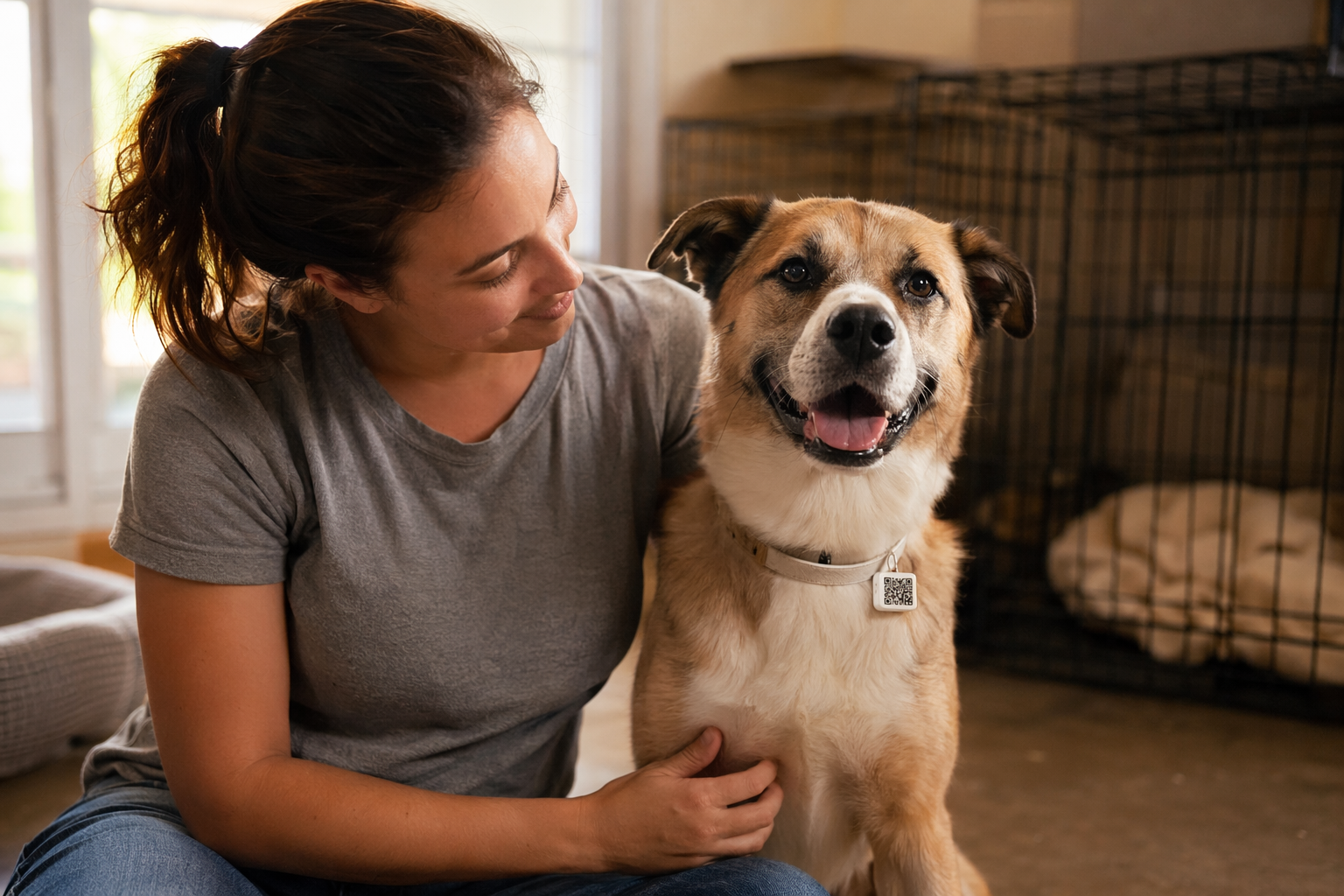
A foster dog's ID situation is unlike any other. The dog is temporarily in your home but belongs to the rescue organisation. Their name may change at adoption. Their medical history may be incomplete. They could be with you for three days or three months — and the phone number engraved on a standard tag becomes wrong data the moment they move to their next placement. A standard engraved ID tag, bought at a pet shop and scratched with your number, simply doesn't cover this. Here's what actually works — and why getting it right matters more for foster dogs than almost any other.
Why foster dogs need different ID thinking
When you take in a foster dog, you're stepping into a situation that an engraved tag wasn't designed for. The usual model — one owner, one phone number, one permanent address — breaks down immediately. Consider what makes a foster placement different:
- Foster placements change every few weeks or months. An engraved tag with the foster parent's phone number is already a problem waiting to happen. That number becomes stale with every new placement — but the tag stays on the collar.
- The rescue organisation's number is the permanent contact. The foster parent's number is temporary. The rescue's number is the one that will always lead somewhere useful, regardless of who currently has the dog.
- The dog may not have a settled name yet. Some rescues rename dogs at adoption. A tag engraved with "Buddy" becomes incorrect the day the adopter decides to call him "Archie."
- The escape risk is highest at the start. New foster placements are the most dangerous period. The dog doesn't know the smells, the sounds, the layout of the house, or where the exits are. Stress-induced flight behaviour — bolting through a door or gate — is most likely in the first two weeks. This is exactly when the ID situation is least sorted.
These factors together mean that the standard approach to dog ID — engrave it once and forget it — creates a false sense of security for foster dogs. The tag on the collar may be completely wrong about who to call, what the dog's name is, and who is responsible for them.
What to put on a foster dog's engraved tag
If you're going the engraved route — or if the rescue provides a tag at intake — here's how to use those limited lines of text as effectively as possible:
- Rescue organisation name and contact number. This is the most important line. It's the permanent contact that doesn't change with each foster placement. If a stranger finds this dog in any foster home, calling the rescue org gets them to the right people.
- The word "Foster". One word that tells a finder this dog is in a temporary home. It sets expectations correctly and signals that whoever picks up the rescue's number will have the context to help.
- Dog's current name. Even if it's temporary, a finder who can call your dog by name is more likely to calm them down and keep them safe. Use the name the dog currently responds to.
- "Microchipped" if applicable. A single word that prompts a finder to take the dog to a vet or shelter for a scan — and confirms the dog is registered and has an organisation behind them.
- Foster parent's number as secondary, if space allows. Knowing this number changes with every placement is exactly what makes the case for a QR tag, but if you have a line to spare, include it.
Keep it simple. The rescue org's number is the single most important piece of information on a foster dog's tag. Everything else is a bonus. A tag that reads "[Rescue Name] / [Rescue Number] / FOSTER" is already more useful than most.
Where a QR tag solves the foster-specific problem
The fundamental problem with any engraved tag for a foster dog is that it captures a single moment in time and freezes it there. A QR tag works differently: the physical tag stays the same, but the profile behind it is updated whenever anything changes. For a foster dog, this is the difference between useful ID and misleading ID.
Here's how it works in practice for a rescue organisation:
- The rescue org sets up the Tagback profile once. The QR tag is attached to the dog's collar at intake. The profile shows the rescue's permanent contact number — and this never changes, regardless of which foster has the dog.
- When a new foster parent takes the dog, they're added to the profile. Their number, their address, their emergency contact — all visible to anyone who scans the tag. When the placement ends, the profile is updated. The physical tag never moves.
- The profile shows everything a finder needs: rescue org contact, current foster parent's number, the dog's current photo, any behavioural notes (fearful, doesn't approach strangers, responds to "Buddy"), and known medical information.
- When the dog is adopted, the profile updates to the new owner's information. Name, contact, vet details — same physical tag, zero reprinting. The entire lifecycle of the dog is managed through one profile.
For a rescue organisation managing dozens of foster placements, this isn't just convenient — it closes a genuine safety gap. Every dog in foster care has current, correct contact information attached to their collar at all times, without anyone ordering new tags or chasing up whether a foster parent remembered to update their disc.
Emergency information for foster dogs
A foster dog's profile should carry more detail than a typical pet owner's tag — because the person who finds a loose foster dog may know nothing about rescue protocols, and the dog themselves can't fill in the blanks. Here's what matters most:
- Medical history from rescue vet records: vaccinations status, known conditions, any medications and dosing schedule. If the dog is on heartworm prevention or is mid-course on antibiotics, a finder needs to know.
- Behavioural notes — these are critical. A dog who is fearful of men, resource guards food, or is reactive to other dogs is not safe to approach the same way as a friendly Labrador. "Fearful — do not corner, let dog approach you" on a profile can prevent a bite and get the dog home safely.
- Rescue org's emergency vet protocol. Some rescues have accounts at specific clinics, or have emergency contacts who authorise treatment. A finder who takes the dog to the wrong vet may face a bill the rescue can't cover — or a treatment decision made without the right context.
- Microchip number. Not just the word "microchipped" — the actual number. So a vet can confirm the chip is registered to the rescue, and so the record can be updated when the dog is adopted.
A good QR profile for a foster dog is essentially a handover document for any kind stranger who finds themselves holding a dog they don't know, at a time when no one expected anything to go wrong. Write it for that person.
The escape-risk window: the first two weeks
If there is one thing every foster parent should know, it's this: the first two weeks of a new placement are the highest-risk period for escape. It's not the dog being badly behaved. It's the dog being a dog — an animal in an unfamiliar environment with no established sense of home, scent, or safe boundaries.
A dog who has been in rescue long enough to be stressed, or who came from a neglectful situation, may bolt the moment a door opens unexpectedly. Some foster dogs are experienced escapers. Others are simply frightened. The behaviours look different but the outcome is the same: a loose dog in an unfamiliar neighbourhood with no idea how to get back.
- Gate checks and door awareness are essential in the first fortnight. Tell everyone in the house — including visitors — that the dog is new and may bolt. Put a note on the front door if it helps.
- Walk on a double lead for the first two weeks. A lead attached to both collar and harness means a slipped collar doesn't mean a lost dog.
- Make sure the collar fits correctly before anything else. Two fingers between the collar and the dog's neck — no more, no less. A loose collar on a panicked, backwards-walking dog will come off in seconds.
- A QR tag means anyone who spots the dog immediately has what they need. A neighbour two streets away who catches a glimpse of a running dog can scan the tag, see the foster parent's number, and call before the dog gets further. This is the scenario where a QR tag pays for itself on the first day.
A note for rescue organisations: consider providing a Tagback tag as part of your standard foster onboarding kit. Alongside the crate, the food transition guide, and the behavioural notes, every dog who leaves your care should have a QR tag already set up with your organisation's permanent contact. It takes five minutes per dog and closes a gap that costs rescues — and dogs — dearly.
Managing ID through the adoption
One of the underappreciated advantages of a QR tag for rescue dogs is how cleanly it handles the transition to permanent ownership. Instead of the adopter needing to order a new tag, wait for it to arrive, and then transfer it to a collar that may not be theirs yet, the ID management happens digitally — in minutes, on adoption day.
- During the foster period: the rescue org's number is permanently on the physical tag. The QR profile shows both the rescue's contact and the current foster parent's number, plus all relevant dog information.
- On adoption day: the new owner is handed the tag and the profile access. They update the name (if they're changing it), add their own contact number, their vet's details, and their address. The rescue org's number can be replaced or left as a secondary contact — their choice.
- Same physical tag, entire lifecycle managed. A tag that went on a rescue dog's collar at intake can still be on that dog's collar five years later, with entirely current information — because the profile behind the QR code grows with the dog.
- Continuity of history matters. If the new owner reads through the profile they've been handed, they'll see the dog's full medical history, any behavioural notes from foster parents, and a photo timeline. That context is genuinely useful — and it survives the handover only because it was kept digitally.
The physical tag is just the beginning. What it points to — the profile, the history, the contacts — is the actual value. And for a rescue dog who may pass through several hands before finding a permanent home, that continuity is something an engraved disc can never provide.
Foster parents give dogs a second chance. Getting the ID right is one of the simplest, most practical parts of that job — and with a QR tag set up through the rescue, it's also one of the least time-consuming. The tag goes on the collar at intake and stays current through every placement, every handover, and every adoption, with no reprinting and no guessing about whether the number on the disc still works.
FAQ
Should a foster dog wear the rescue org's tag or the foster parent's tag?+
Both, if possible. The rescue org's number is the permanent one — it should always be on the collar. The foster parent's number can be on a second tag or as part of a QR profile that the org updates with each placement. If you can only have one, the rescue org's contact wins: it's the number that will always lead somewhere useful, regardless of who currently has the dog.
What if the foster dog escapes in the first week?+
The first two weeks of a new placement are the highest-risk period. Make sure the collar fits correctly (two-finger rule between collar and neck), both tags are securely attached, and the QR profile shows both the rescue and foster parent's numbers. Walk on a double lead — attached to both collar and harness — for the first two weeks. A QR tag means anyone in the neighbourhood who spots the dog can contact the rescue or foster parent in seconds, before the dog gets further away.
Can the same QR tag transfer to the adopter?+
Yes. With Tagback, the profile can be updated to the new owner's information after adoption — name, contact number, vet details, and anything else relevant. The physical tag stays the same. The adopter just updates the profile online, which takes a few minutes. The same tag that went on the dog at rescue intake can still be on their collar five years later, with entirely current information.
Do rescue organisations provide ID tags for foster dogs?+
Practices vary widely. Some rescues provide a tag with their organisation's number at intake; others leave the responsibility to foster parents, which means coverage is inconsistent. Asking the rescue what their protocol is — and suggesting a QR tag system as part of onboarding — is worth raising early. A Tagback tag set up by the organisation at intake costs nothing and ensures every foster dog leaves with current, correct ID already in place.
Start protecting what matters
Tagback is free, forever. No subscription. No app needed for finders.
Create your free tag