
Lost Car Keys With No Spare: A Step-by-Step Guide
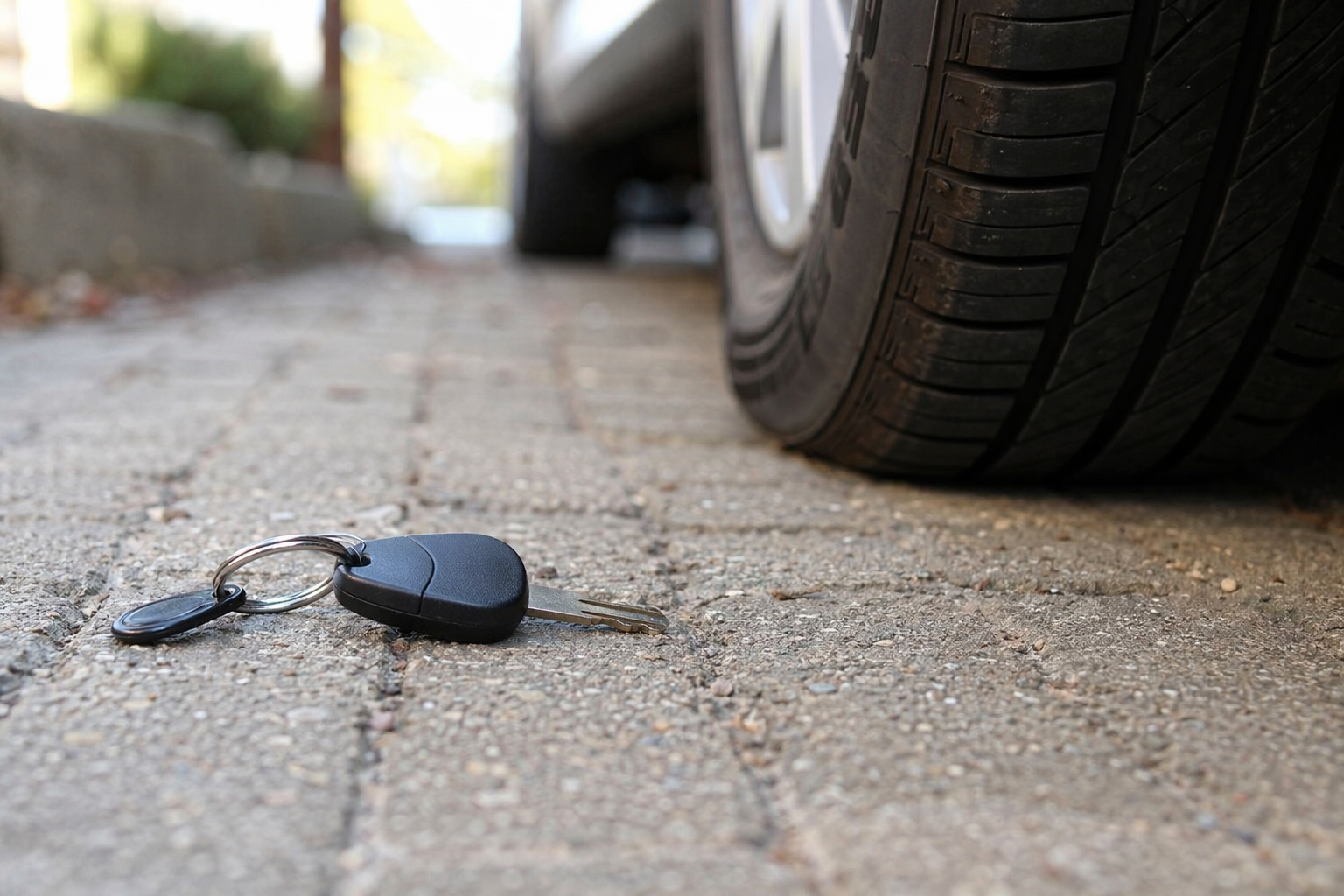
Losing your car keys is one of the most expensive "small" losses you can have — replacing a modern smart key fob can run up to $650. And if you're stranded right now, you don't need a history lesson. Here's the fastest path back into your car, in order of speed and cost.
Step 1: Search Properly — Not Just "Look Around"
Before you call anyone, do one focused, methodical sweep. Stress narrows your attention and you will miss obvious spots. Go through these deliberately:
- Every coat and jacket pocket — including the ones hanging by the door that you haven't worn this week
- Every compartment in your bag or backpack — including the small zippered ones you never use
- Under and between car seats — keys slide far under seats when they fall
- The gym locker or bag you used last — a very common spot after a workout
- Your desk drawer at work — especially if you set them down when you got in
- Bathroom counter or shelf — easy to put down while washing hands
- Nightstand and between sofa cushions — if you got home last night and can't find them this morning
- Freezer, fridge, or kitchen counter — it sounds strange, but it happens constantly
Give yourself five focused minutes. If nothing turns up, move on — don't keep searching in hope. Time is money here.
Step 2: If You Have a Spare — Go Get It
If you have a spare key at home or with a trusted person, this is your cheapest and fastest option. Consider:
- Call someone at home — a family member or roommate who can bring it to you
- Grab an Uber or rideshare home and back — even a $30 round trip is far cheaper than a locksmith
- Call a friend or coworker nearby — if the spare is at their place or your office
If you have a spare but it's at home and you're somewhere far, still consider this route — it's almost always cheaper than the alternatives below. While you wait for the ride, use the time to cancel any commitments and start thinking about where your original keys might be.
No Spare: Your Three Options
No spare in play? You have three realistic paths. Here they are in order of speed:
- Locksmith (fastest, mid-cost). An automotive locksmith can often cut and program a new key on-site. Cost runs $150–$400 depending on key type and your location. Call a local locksmith directly — not an aggregator app — and confirm they handle your car's make and year before they come out.
- Roadside assistance (check first, may be free). If you have AAA, check your auto insurance policy, or a credit card with roadside benefits — many will dispatch a locksmith at no charge or low cost. This is the first call you should make if you have any of these. Wait times vary from 30 minutes to over two hours.
- Dealership (slowest, most expensive). Your dealer can always replace your key — but they usually require your car to be towed to them, need proof of ownership, and charge a premium for parts and labor. Budget $250–$650+ and a wait of several hours to several days if they need to order a key. Use this as a last resort or if you need it documented for insurance.
Key Fob Types and What Replacement Actually Costs
Replacement cost depends almost entirely on what type of key you have. Here's a quick breakdown:
- Basic metal key (older vehicles) — $10–$50. Can be cut at a hardware store or locksmith. No programming needed.
- Transponder key — $150–$300. Has a chip inside the key head that must be programmed to your car's immobilizer. Requires a locksmith or dealer with programming equipment.
- Remote key fob (separate fob + key) — $100–$400. The fob needs programming; the key may need cutting. Aftermarket fobs are cheaper but not always reliable.
- Smart key / push-button start fob — $200–$650+. No physical key to cut, but the fob must be cryptographically paired to your car. Dealers charge the most here because of proprietary programming tools.
Why is the dealer always more expensive? Because they're using their own branded tools, genuine OEM parts, and billing at dealership labor rates — often $120–$200/hour. An independent locksmith uses the same programming databases but with lower overhead. Unless your car is under warranty or you need paperwork for insurance, the dealer is rarely the right first call.
If You Think Your Keys Were Stolen
If your keys are missing in a context where theft is possible — your bag was out of sight, you were in a crowd, or you know your car was broken into — treat it differently:
- File a police report. Even if nothing comes of it, you'll need documentation for insurance claims and it creates a record.
- Consider re-keying or changing your car locks. If a thief has your key, they can return for your car. Talk to a locksmith about rekeying.
- If your home key was on the same ring — seriously consider changing your home locks. A physical key with no address is low risk, but if you had mail, a gym membership card, or anything with your address nearby, the risk goes up.
- Contact your insurance company. Comprehensive auto insurance often covers key theft. Home insurance may cover lock replacement.
Trackers: AirTag, Tile, and GPS — When They Work (and When They Don't)
If you're reading this mid-crisis wishing you had a tracker on your keys, here's a realistic picture of what Bluetooth and UWB trackers actually do:
- AirTag / Find My (Apple) — Excellent precision tracking when within Bluetooth range (~10m). Uses the Find My network (nearby iPhones) to update location when out of range. Works well in cities; less reliable in rural areas. Requires an iPhone.
- Tile — Similar Bluetooth approach with its own crowd network. Works on Android and iPhone. Smaller network than Apple's in most regions.
- GPS trackers — Continuous real-time location anywhere with cell coverage, but bulkier, require a subscription, and need periodic charging. Overkill for a keychain.
- The key limitation: All Bluetooth trackers only update location when a network device passes nearby. If your keys are sitting in a quiet room or a rural area with no recent passerby, the last known location may be hours old.
Trackers are excellent for "I left them somewhere around the house" scenarios. They are less reliable for "I lost them outside somewhere." They also do nothing if someone finds your keys — the finder can't use the tracker to contact you without knowing your private info.
Prevention: So This Never Happens Again
You're going to fix this situation today. Make sure you don't have to again:
- Get a spare key made immediately — as soon as this is resolved. Cut a basic key at a hardware store for backup; for transponder keys, have a locksmith program a spare while you have your original in hand. Store it somewhere you'll actually remember.
- Install a key hook by your front door — a single hook that is the one place keys always go. Habit beats memory every time.
- Add a Bluetooth tracker to your keychain — AirTag or Tile. It won't solve every scenario, but it recovers 80% of lost-at-home situations instantly.
- Add a QR recovery tag to your keychain — this covers the scenario trackers can't: someone else finds your keys. A QR tag lets the finder contact you immediately, without needing your address or phone number. They scan, leave a message, and you get notified.
A Tagback QR tag on your keychain means the next person who finds your keys can reach you in seconds — no personal info exposed. It's the one recovery method that works even when your phone is dead, the tracker is out of range, and your keys are across town.
FAQ
How much does it cost to replace a key fob?+
It depends on your key type. A basic transponder key runs $150–$300 through a locksmith. A smart key or push-button start fob can cost $200–$650 or more, especially at a dealership. Locksmiths are typically $100–$200 cheaper than dealers for the same job.
Can a locksmith make a car key without the original?+
Yes. An automotive locksmith can decode your car's lock mechanically or via OBD port and cut and program a new key without the original. You'll need to show proof of ownership (registration and ID) and the car must usually be present. Not all locksmiths handle all makes — confirm before they come out.
Should I call a locksmith or a dealer?+
Call a locksmith first in almost every case. They're faster, cheaper, and come to you. Dealers require a tow in most cases, charge higher labor rates, and may take days if they need to order a key. The main reason to use a dealer is if your car is under warranty, you need official documentation, or your car has a security system that only the dealer can reset.
What should I do if I think my car keys were stolen?+
File a police report immediately, even if it feels minor — you'll need it for insurance. If your home key was on the same ring and you have any reason to think the thief knows your address, change your home locks. Contact your auto and home insurance providers, as key theft is often covered under comprehensive or contents policies.
Start protecting what matters
Tagback is free, forever. No subscription. No app needed for finders.
Create your free tag