
Perdí las llaves del coche sin repuesto: guía paso a paso
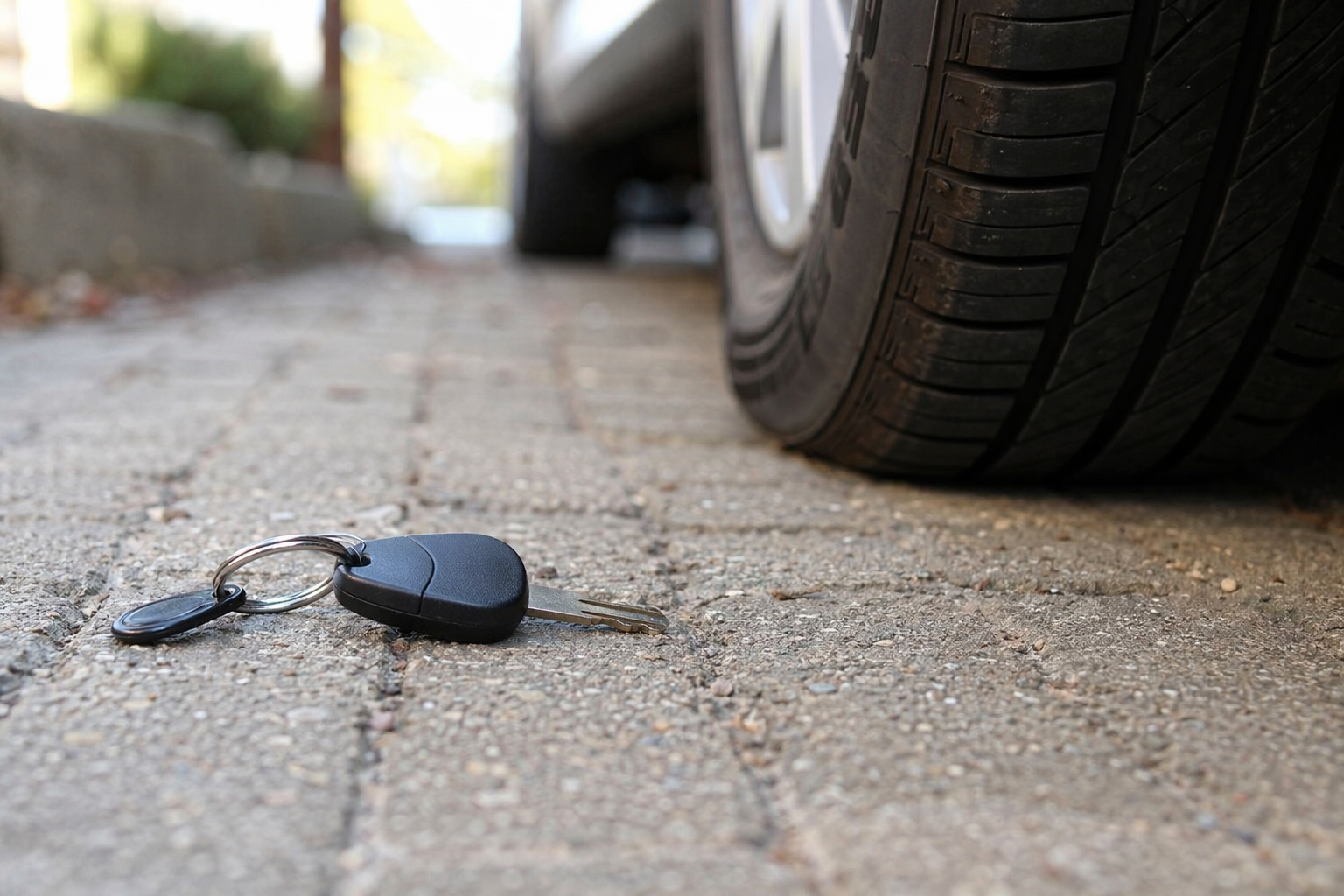
Perder las llaves del coche es una de las pérdidas "pequeñas" más caras que puedes tener: reemplazar un mando moderno inteligente puede costar hasta $650. Y si estás atrapado ahora mismo, no necesitas una lección de historia. Aquí está el camino más rápido para volver a tu coche, en orden de velocidad y coste.
Paso 1: Busca correctamente, no solo "mira alrededor"
Antes de llamar a nadie, haz un barrido concentrado y metódico. El estrés reduce tu atención y pasarás por alto sitios obvios. Revisa estos puntos deliberadamente:
- Every coat and jacket pocket — including the ones hanging by the door that you haven't worn this week
- Every compartment in your bag or backpack — including the small zippered ones you never use
- Under and between car seats — keys slide far under seats when they fall
- The gym locker or bag you used last — a very common spot after a workout
- Your desk drawer at work — especially if you set them down when you got in
- Bathroom counter or shelf — easy to put down while washing hands
- Nightstand and between sofa cushions — if you got home last night and can't find them this morning
- Freezer, fridge, or kitchen counter — it sounds strange, but it happens constantly
Date cinco minutos concentrados. Si no aparece nada, sigue adelante: no sigas buscando con esperanza. Aquí el tiempo es oro.
Paso 2: Si tienes un repuesto, ve a buscarlo
Si tienes una llave de repuesto en casa o con una persona de confianza, esta es tu opción más rápida y barata. Considera:
- Call someone at home — a family member or roommate who can bring it to you
- Grab an Uber or rideshare home and back — even a $30 round trip is far cheaper than a locksmith
- Call a friend or coworker nearby — if the spare is at their place or your office
Si tienes un repuesto pero está en casa y tú estás lejos, considera igualmente esta opción: casi siempre es más barata que las alternativas siguientes. Mientras esperas el viaje, aprovecha el tiempo para cancelar cualquier compromiso y pensar dónde pueden estar tus llaves originales.
Sin repuesto: tus tres opciones
¿No tienes repuesto disponible? Tienes tres caminos realistas. Aquí están en orden de velocidad:
- Locksmith (fastest, mid-cost). An automotive locksmith can often cut and program a new key on-site. Cost runs $150–$400 depending on key type and your location. Call a local locksmith directly — not an aggregator app — and confirm they handle your car's make and year before they come out.
- Roadside assistance (check first, may be free). If you have AAA, check your auto insurance policy, or a credit card with roadside benefits — many will dispatch a locksmith at no charge or low cost. This is the first call you should make if you have any of these. Wait times vary from 30 minutes to over two hours.
- Dealership (slowest, most expensive). Your dealer can always replace your key — but they usually require your car to be towed to them, need proof of ownership, and charge a premium for parts and labor. Budget $250–$650+ and a wait of several hours to several days if they need to order a key. Use this as a last resort or if you need it documented for insurance.
Tipos de mandos y cuánto cuesta realmente el reemplazo
El coste de reemplazo depende casi por completo del tipo de llave que tengas. Aquí tienes un desglose rápido:
- Basic metal key (older vehicles) — $10–$50. Can be cut at a hardware store or locksmith. No programming needed.
- Transponder key — $150–$300. Has a chip inside the key head that must be programmed to your car's immobilizer. Requires a locksmith or dealer with programming equipment.
- Remote key fob (separate fob + key) — $100–$400. The fob needs programming; the key may need cutting. Aftermarket fobs are cheaper but not always reliable.
- Smart key / push-button start fob — $200–$650+. No physical key to cut, but the fob must be cryptographically paired to your car. Dealers charge the most here because of proprietary programming tools.
¿Por qué el concesionario es siempre más caro? Porque usan sus propias herramientas de marca, piezas OEM genuinas y facturan a tarifas de mano de obra de concesionario, a menudo $120–$200/hora. Un cerrajero independiente usa las mismas bases de datos de programación pero con menos gastos generales. A menos que tu coche esté en garantía o necesites documentación para el seguro, el concesionario rara vez es la primera llamada correcta.
Si crees que te robaron las llaves
Si tus llaves desaparecieron en un contexto donde el robo es posible (tu bolso estuvo fuera de vista, estabas en una multitud, o sabes que forzaron tu coche), trátalo de manera diferente:
- File a police report. Even if nothing comes of it, you'll need documentation for insurance claims and it creates a record.
- Consider re-keying or changing your car locks. If a thief has your key, they can return for your car. Talk to a locksmith about rekeying.
- If your home key was on the same ring — seriously consider changing your home locks. A physical key with no address is low risk, but if you had mail, a gym membership card, or anything with your address nearby, the risk goes up.
- Contact your insurance company. Comprehensive auto insurance often covers key theft. Home insurance may cover lock replacement.
Rastreadores: AirTag, Tile y GPS: cuándo funcionan (y cuándo no)
Si estás leyendo esto en medio de una crisis deseando tener un rastreador en tus llaves, aquí tienes una imagen realista de lo que los rastreadores Bluetooth y UWB realmente hacen:
- AirTag / Find My (Apple) — Excellent precision tracking when within Bluetooth range (~10m). Uses the Find My network (nearby iPhones) to update location when out of range. Works well in cities; less reliable in rural areas. Requires an iPhone.
- Tile — Similar Bluetooth approach with its own crowd network. Works on Android and iPhone. Smaller network than Apple's in most regions.
- GPS trackers — Continuous real-time location anywhere with cell coverage, but bulkier, require a subscription, and need periodic charging. Overkill for a keychain.
- The key limitation: All Bluetooth trackers only update location when a network device passes nearby. If your keys are sitting in a quiet room or a rural area with no recent passerby, the last known location may be hours old.
Los rastreadores son excelentes para escenarios de "los dejé en algún lugar de la casa". Son menos fiables para "los perdí en algún lugar fuera". Tampoco sirven si alguien encuentra tus llaves: el que las encuentra no puede usar el rastreador para contactarte sin conocer tu información privada.
Prevención: para que esto nunca vuelva a pasar
Vas a solucionar esta situación hoy. Asegúrate de no tener que hacerlo otra vez:
- Get a spare key made immediately — as soon as this is resolved. Cut a basic key at a hardware store for backup; for transponder keys, have a locksmith program a spare while you have your original in hand. Store it somewhere you'll actually remember.
- Install a key hook by your front door — a single hook that is the one place keys always go. Habit beats memory every time.
- Add a Bluetooth tracker to your keychain — AirTag or Tile. It won't solve every scenario, but it recovers 80% of lost-at-home situations instantly.
- Add a QR recovery tag to your keychain — this covers the scenario trackers can't: someone else finds your keys. A QR tag lets the finder contact you immediately, without needing your address or phone number. They scan, leave a message, and you get notified.
Una etiqueta QR de Tagback en tu llavero significa que la próxima persona que encuentre tus llaves puede contactarte en segundos, sin exponer información personal. Es el único método de recuperación que funciona incluso cuando tu teléfono está descargado, el rastreador está fuera de alcance y tus llaves están al otro lado de la ciudad.
Preguntas frecuentes
¿Cuánto cuesta reemplazar un mando de coche?+
Depende del tipo de llave. Una llave transponder básica cuesta $150–$300 con un cerrajero. Un mando inteligente o de arranque sin llave puede costar $200–$650 o más, especialmente en un concesionario. Los cerrajeros suelen ser $100–$200 más baratos que los concesionarios para el mismo trabajo.
¿Puede un cerrajero hacer una llave de coche sin la original?+
Sí. Un cerrajero automotriz puede decodificar la cerradura de tu coche mecánicamente o mediante el puerto OBD y cortar y programar una llave nueva sin la original. Deberás mostrar prueba de propiedad (registro e identificación) y el coche normalmente debe estar presente. No todos los cerrajeros trabajan con todas las marcas: confírmalo antes de que vengan.
¿Debería llamar a un cerrajero o a un concesionario?+
Llama primero a un cerrajero en casi todos los casos. Son más rápidos, más baratos y van a donde estés. Los concesionarios requieren remolque en la mayoría de casos, cobran tarifas de mano de obra más altas y pueden tardar días si necesitan pedir una llave. La razón principal para usar un concesionario es si tu coche está en garantía, necesitas documentación oficial o tu coche tiene un sistema de seguridad que solo el concesionario puede reiniciar.
¿Qué debo hacer si creo que me robaron las llaves del coche?+
Presenta un informe policial inmediatamente, aunque parezca algo menor: lo necesitarás para el seguro. Si tu llave de casa estaba en el mismo llavero y tienes alguna razón para pensar que el ladrón conoce tu dirección, cambia las cerraduras de tu casa. Contacta con tus proveedores de seguro de auto y hogar, ya que el robo de llaves suele estar cubierto por pólizas a todo riesgo o de contenidos.
Start protecting what matters
Tagback is free, forever. No subscription. No app needed for finders.
Create your free tag