
Found a Lost Dog? Here's Exactly What to Do Step by Step
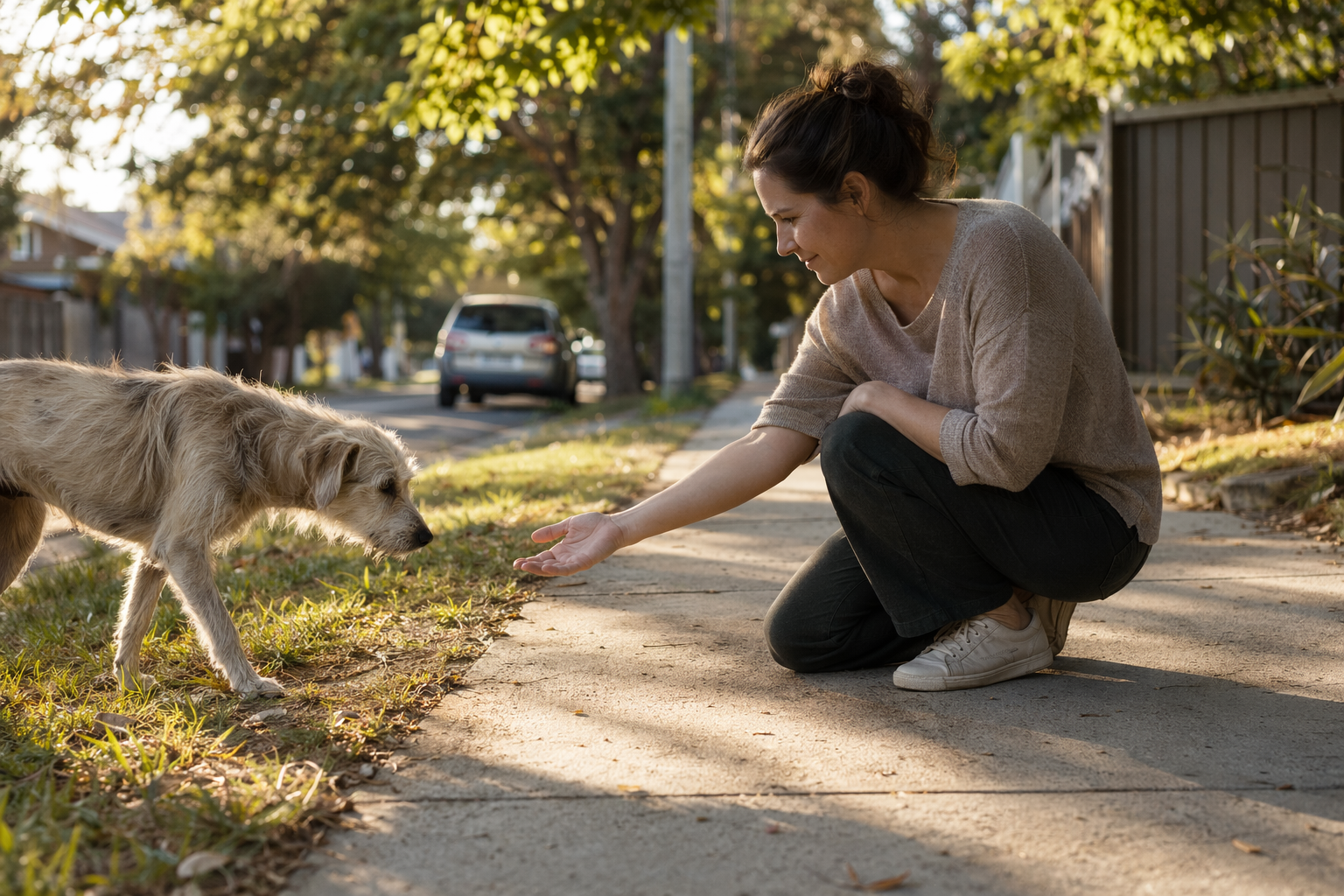
You've found a dog wandering alone. Maybe it looked lost, maybe it ran up to you, maybe it's been sitting on the same corner for an hour. Whatever the situation, the next thirty minutes matter more than anything that comes after. This guide is for the finder — the person holding the lead (or trying to) — not the owner. Here's the complete sequence, from the moment you spot the dog to reuniting it with its family.
Step 1 — Approach safely: not every stray dog is friendly
Before you do anything else, assess the dog from a distance. A dog that's lost is also a dog that's stressed, and a stressed dog can behave unpredictably — even a normally gentle one.
- Watch the body language first. Tail low or tucked, ears back, body crouched, hackles raised — these are signs of fear. A dog showing these signals may snap if you approach too fast. A dog with a relaxed tail wag and loose body is almost certainly safe to approach.
- Crouch down, turn slightly sideways, and avoid direct eye contact. Direct eye contact is a challenge signal in dog language. Make yourself small and non-threatening, and let the dog come to you if it wants to.
- Offer the back of your hand slowly for the dog to sniff before attempting to touch it. Never reach over a dog's head on first contact.
- Don't chase a frightened dog. You will not catch it, and you'll push it further away — possibly into traffic. A stationary, non-threatening presence with food is far more effective.
- If the dog is aggressive or clearly terrified, do not attempt physical contact. Call your local animal control — they carry catch poles and snares and are trained to handle exactly this situation. Note the location precisely and call.
If the dog lets you approach, get a makeshift lead on it as soon as you safely can. A belt, a spare shoelace, or a looped length of rope all work. Once the dog is secured, you can move through the rest of these steps calmly.
Step 2 — Check for ID: collar tag, QR code, or no tag at all
This is the step that can end the whole situation in under five minutes — or tell you how much work lies ahead.
- Standard ID tag with a phone number: Call it immediately. If there's no answer, leave a voicemail with your number, the dog's location, and a brief description. Text as well — many people don't answer unknown numbers but check texts.
- QR tag on the collar: Open your phone camera (no app needed), point it at the QR code, and tap the link that appears. A good QR tag — like a Tagback tag — takes you straight to the owner's contact page with the dog's name, photo, and a message button. Tap it, send your location, and the owner gets an instant notification. Reunion time: under ten minutes.
- No tag at all: This is the most common scenario, and it's not a dead end — it just means you move to the next step. A microchip may be the only ID this dog has.
Check the collar carefully — tags get caught in fur, especially on long-haired breeds. Run your fingers around the full collar before concluding there's nothing there.
Step 3 — Get the dog scanned for a microchip (it's free)
A microchip is a small chip — about the size of a grain of rice — implanted under the skin at the back of the neck. It takes about two seconds to scan with a handheld reader. This is the most reliable form of ID a dog can have, and scanning is completely free.
- Any veterinary clinic will scan a found dog at no charge, no appointment needed. Walk in, explain you found a stray, and they'll scan it immediately. If the chip is registered and the owner's contact details are up to date, the vet can reach them right then.
- Most animal shelters and animal control offices also have scanners and will scan free of charge. You don't need to surrender the dog to have it scanned — just ask.
- Some pet supply stores (PetSmart, for example) have scanners at the front desk. Call ahead to confirm.
- If the chip comes back with a name, the vet can contact the registered owner directly. If the details are outdated, ask which registry it's registered with — common ones include HomeAgain, Found Animals, and the AAHA Universal Pet Microchip Lookup at aaha.org. Registries can flag the chip record as "dog found" so the owner sees it if they search.
Don't skip the microchip scan even if you find a phone number on the tag. Microchip records often carry backup contact details, vet information, and the owner's address — useful if the number goes to voicemail.
Step 4 — Post and report: Facebook groups, Nextdoor, Petfinder, and local shelters
The owner is searching. Your job is to make yourself findable — on every channel they're likely to check.
- Post on Nextdoor first. Nextdoor reaches neighbors within a precise local radius — this is where lost-dog reunions happen fastest because the people who see your post live near where the dog went missing. Include the exact street or intersection where you found it.
- Search local Facebook groups before you post. Look for "[your city] lost pets," "[your city] dogs," or "[your city] found pets." The owner may already have a post up — reply directly to theirs instead of creating a new one. Then post your own found-dog notice with a clear photo showing the dog's face and markings.
- Post on PawBoost (pawboost.com) — it sends automated alerts to local rescue volunteers and registered users near your location.
- File a found-dog report with your local animal shelter, even if you're keeping the dog temporarily. Owners check shelters first. You don't need to drop the dog off — just file a report with your contact details and a photo so they can match it if the owner calls.
- Leave a physical note at the exact spot where you found the dog. Laminate it or put it in a ziplock bag to protect it from weather. Owners retrace their dog's steps and walk the route repeatedly.
A note on taking the dog directly to a shelter: most reunions happen faster when the dog stays in the neighborhood where it was found. Shelter intake slows things down — the owner has to know which shelter to check, and dogs can be hard to locate in the system. Posting online and staying put is almost always faster.
Step 5 — Temporary care while you find the owner
If you're keeping the dog temporarily — which is the best thing you can do while searching — here's how to keep it safe and comfortable without complicating things.
- Give the dog a quiet, contained space. A laundry room, a bathroom, or a gated kitchen. The dog is already stressed — a calm, small space helps it decompress. Don't introduce it to your own pets immediately.
- Offer water right away. A dog that's been wandering may be dehydrated. Offer plain water before any food.
- Keep food simple and plain. Plain cooked chicken with no seasoning, white rice, or commercial dog food. Avoid anything with onions, garlic, grapes, raisins, or xylitol (common in peanut butter). You don't know this dog's dietary needs or allergies.
- Don't bathe or groom the dog heavily. The owner may need to identify it, and changing its smell or appearance can complicate this.
- How long should you keep it? Most reunions happen within 48–72 hours of active, visible searching. Give it at least 5–7 days of genuine effort — online posts, the microchip scan, the shelter report, and physical flyers — before drawing any conclusions. Don't assume the owner doesn't care. Dogs go missing when owners are at work, on vacation, or during a brief moment of distraction.
Step 6 — If no owner is found: surrender options vs adoption
After 7–14 days of active searching with no response, you face a real decision.
- Contact breed-specific rescues if the dog is a recognizable breed. Breed rescues vet adopters carefully and often have waiting lists of qualified homes.
- Contact a general dog rescue if the breed is mixed or unknown. They can assess temperament, handle vaccinations, and manage the rehoming process properly.
- If you want to keep the dog yourself, get it examined by a vet, vaccinated, and licensed in your area. In most US states, you are not legally required to surrender a found dog — but you should document your search effort (screenshots of posts, shelter reports) in case the original owner ever comes forward.
- If you absolutely cannot keep it, contact your local animal shelter. Explain the situation and that you've done an active search. Responsible shelters track behavior and health, giving the dog the best chance of placement.
- Do not simply release the dog if you can no longer care for it. Contact a rescue or shelter first — releasing a dog that depended on you puts it in immediate danger.
Why a QR tag changes everything — for your own dog
You've just spent hours helping a stranger's dog. Consider what that experience tells you: the single biggest obstacle to a fast reunion is identification. A dog with no tag, or a tag with an outdated number, can sit at a vet or a neighbor's house for days while its owner searches desperately within half a mile.
A Tagback QR tag on your dog's collar solves this entirely. The finder opens their phone camera, scans the tag, and lands on a page with your dog's name, photo, and a message button. They tap it, send their location, and you get an instant notification. No outdated phone numbers, no vet trips required, no days of uncertainty. Tagback is completely free — no subscription, no paid tiers, no limit on how many pets you register. Ever.
It takes about 60 seconds to set up. If your dog ever gets out — through an open gate, a broken fence, or a moment of distraction — the person who finds it will know exactly what to do and how to reach you.
FAQ
Should I take a found dog to a shelter straight away?+
Not immediately. Most reunions happen faster when the dog stays in the neighborhood where it was found. Post online and check for microchips first — shelters are a last resort, not the first step.
The dog has a tag but the phone number is out of date — now what?+
Ask a vet or shelter to scan for a microchip. Post photos on local Facebook groups and Nextdoor with the tag details visible. If the dog has a QR tag (like Tagback), scanning it opens an always-current contact page.
What if the found dog is aggressive?+
Don't force contact. Call your local animal control — they have the equipment and training to safely handle a fearful or aggressive stray. Aggressive behavior is often fear-based and resolves once the dog feels safe.
How long am I legally responsible for a dog I found?+
Laws vary by jurisdiction, but in most US states you're not legally obligated to keep a found dog. However, contacting animal control documents that you found it, which protects you legally. Many cities require reporting a found dog within 48–72 hours.
Start protecting what matters
Tagback is free, forever. No subscription. No app needed for finders.
Create your free tag