
Personalized Dog Tags: The Complete 2026 Buyer's Guide
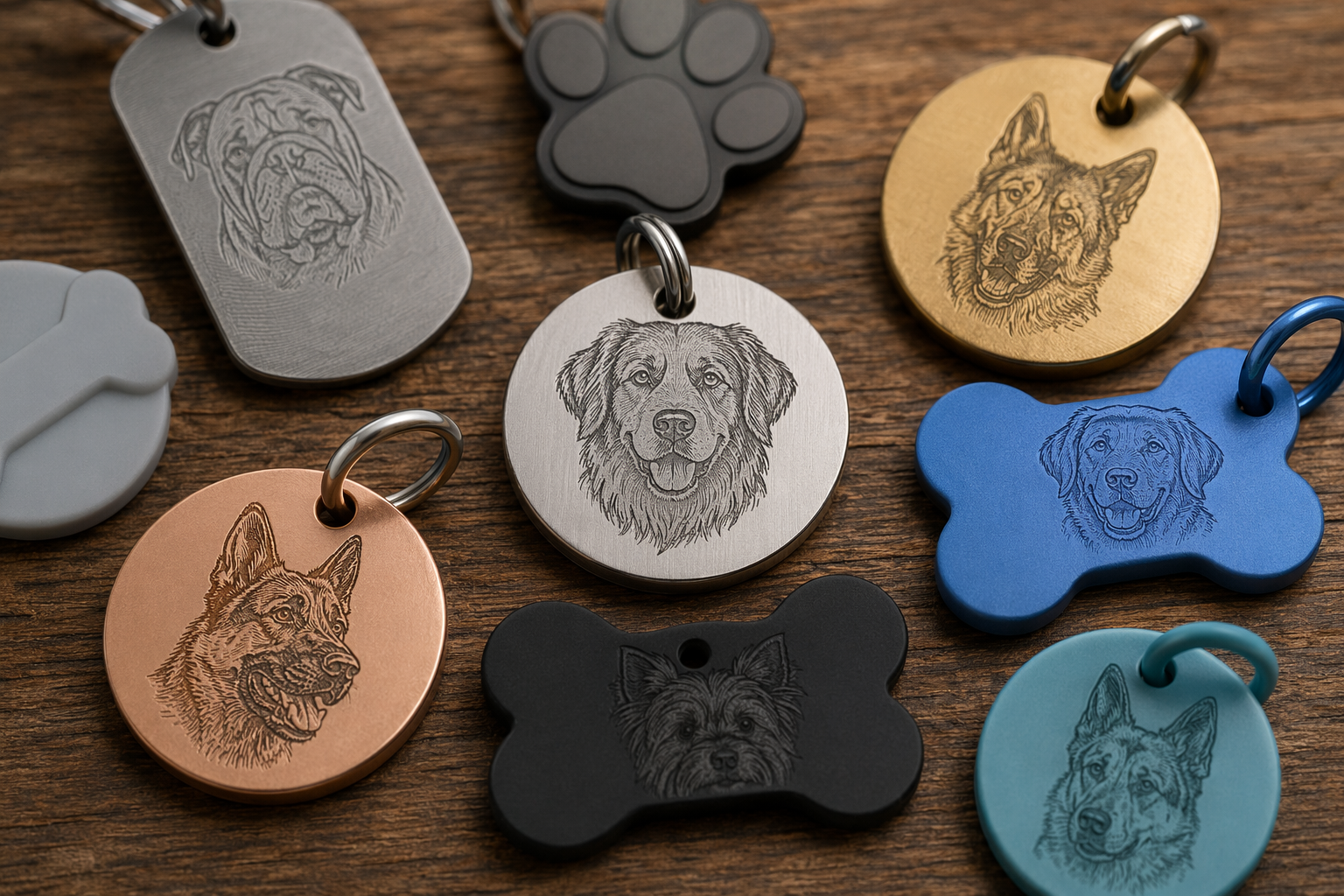
A personalized dog tag costs between $5 and $25. It weighs a few grams. It hangs on your dog's collar every hour of every day. And when your dog bolts — through an open gate, past a distracted dog-walker, out of a car window — it is the first thing a stranger reaches for. The decision you make at the tag machine in PetSmart, or on an Etsy page at midnight, has real consequences. This guide walks through every variable worth considering.
We cover material, engraving method, what to write and what to leave off, shape and size, specialty tag options, and why a QR code tag belongs on the same collar as your engraved disc. By the end, you'll know exactly what to order — and why.
Material: aluminum, stainless steel, brass, silicone — what lasts
The material your custom dog tag is made from determines how long the engraving stays readable — and readable engraving is the only engraving that matters. Here is how the main materials compare:
- Stainless steel is the gold standard. It resists rust, corrosion, and saltwater. It holds laser engraving sharply for five or more years on an active dog. It is heavier than aluminum but not uncomfortably so for medium and large breeds. For any dog that swims, hikes, or spends time outdoors in variable weather, stainless is the right call.
- Brass is nearly as durable as stainless and develops a warm patina over time. It is slightly softer, which means it can dent on impact, but it holds engraving well and does not corrode easily. A brass custom dog tag is a good option if you want durability with a slightly warmer aesthetic.
- Aluminum is the most common material at kiosk machines and the cheapest option online. It works fine for low-activity indoor dogs, but dents easily, and the engraving on cheap stamped aluminum can become difficult to read within 12–18 months on an active dog. If you choose aluminum, spend a little more on laser engraving rather than stamping.
- Silicone is the exception to the material conversation. Silicone tags are soft, flexible, and completely silent — no jingle. They are usually slide-on collar tags rather than hanging discs. The trade-off: they cannot be traditionally engraved. Text is embossed or printed, which means it fades faster. Silicone is excellent as a noise-free secondary tag on a dog whose clanking drives you mad at night.
- Acrylic and bone-style tags are popular for their shape options but typically use printed rather than laser-etched text. They look distinctive, but the print will fade faster than engraving on metal. Use them as decorative tags rather than primary ID.
Engraving methods: laser engraving vs stamping (quality difference matters)
How the text gets onto the metal matters almost as much as the metal itself. There are two main methods: stamping and laser engraving.
Stamping is the method used by most pet store kiosk machines. A die presses letters into the metal surface, creating shallow indentations. It is fast — typically two minutes — but the grooves are shallow and begin to wear from day one. On a tag that scrapes against food bowls, concrete, and other collar hardware daily, stamped text can become difficult to read within a year or two.
Laser engraving uses a focused beam to vaporize material from the surface, creating deeper, sharper, and more consistent cuts. The result is a tag that holds its text far longer — typically three to five years on an active dog, and longer on stainless steel. Most reputable online custom dog tag sellers use laser engraving as standard. The trade-off is that you wait three to five days for delivery instead of walking out of the store with a tag.
The practical recommendation: if you need a tag today, use the kiosk and order a better laser-engraved replacement online at the same time. Keep the kiosk tag on the collar until the better one arrives.
What to engrave — and the 4-line character limit problem
A standard 1.25-inch round tag gives you approximately four lines of text. That is not a lot of room, and the temptation to fill every line with useful-sounding information works against readability. Here is what actually belongs on a personalized dog tag:
- Your dog's name. A finder who knows the dog's name can call it, calm it, and stop it from running. A named dog is also more likely to be perceived as a loved pet rather than a stray.
- Your primary mobile number. The number you answer at any hour, on any day. Not a work line. Not a home landline. The phone in your pocket.
- A secondary number (if space allows). A partner, a parent, a trusted neighbour. If your phone is flat or you're in a meeting, someone else can take the call.
- One short note if critical — "Microchipped" prompts a finder to visit a vet for a scan. "Diabetic" or "Epileptic" tells a finder the dog needs fast care. Only use this line if the information is genuinely urgent.
What to leave off: your home address (a security risk — it signals your house may be empty), your email address (no one emails while holding a dog), cute phrases, and sentimental text. Every non-essential line competes with the phone number that actually gets your dog home.
The deeper problem with engraving is that information goes stale. Phone numbers change. You move. Your vet changes. An engraved tag is a snapshot of your contact information at the moment it was made — frozen there permanently. The tag on your dog's collar right now: is that number still active? When was it made?
Shape and size: matching the tag to the dog
Personalized dog tags come in a wide range of shapes: round, bone, heart, shield, house, paw, star. Shape is partly aesthetic — but it also affects how much text fits and how the tag sits on the collar.
- Round tags are the most practical shape for engraving. The circular surface maximises the number of characters per line, and round tags spin on the ring so all sides are accessible. A 1.25-inch round tag is the standard for medium to large dogs.
- Bone and shield shapes have straight edges that can hold slightly more text on the longer dimension, but awkward corners can reduce line count depending on the supplier's template. They look distinctive and work well for dogs with a personality to match.
- Heart tags are popular for smaller breeds and cats. The tapered bottom reduces usable engraving area — ensure the supplier's preview shows all your text fitting before ordering.
- Shield and military-style tags are flat and rectangular, which makes them good for dogs with thick fur where a dangling disc can hide. They also lie flat against the chest and make less noise.
- Size guidance by breed: small dogs (under 10kg) do best with a 0.75–1 inch tag. Medium dogs (10–25kg) use 1–1.25 inches. Large and giant breeds can carry 1.5-inch tags without issue, and the larger surface allows more text at a readable font size.
Silicone sleeve tags, glow-in-dark, and specialty tags
Beyond the standard engraved disc, a small market of specialty tag types has developed to solve specific problems. Most are complementary rather than replacement options.
- Silicone sleeve tags slide onto the collar itself rather than hanging from a ring. They are completely silent — the primary advantage for dogs (and owners) who find tag jingle intolerable. Text is embossed directly into the silicone. The limitation is that embossed text fades faster than engraving, and the tags can slide along the collar and end up under the dog's chin where they are harder to find. Use alongside a hanging metal tag rather than instead of one.
- Glow-in-dark and LED tags improve visibility at night for dogs walked in low-light conditions. The glow layer is usually a coating rather than the engraving surface itself. These are useful safety additions but are not a substitute for readable contact information — ensure the engraved side of a glow tag is still legible before relying on it.
- Riveted or screw-back tags attach directly to the collar without a ring, which reduces noise and eliminates the risk of the tag detaching. They are harder to read quickly because they require removing or rotating the collar.
- Double-sided tags let you use both faces — contact info on one side, medical or secondary info on the other. Useful when you have more information than fits on one side, but be aware that a finder will only see one face at a time.
- Barrel tags (also called capsule tags) screw open to hold a small paper insert with detailed information. They are essentially a low-tech precursor to QR tags — clever in concept but unreliable in practice, as the paper can become wet, illegible, or lost.
QR code layer: what engraving can't do
A custom engraved dog tag — even a perfect one — has hard limits. Four lines of text. No photo. No medical history. No way to update it when your phone number changes. No lost mode alert. An engraved tag is a static object, and life is not static.
A QR tag solves the information problem entirely. The physical tag is small — typically a disc or slim rectangle with a single scannable code. Any finder with a modern smartphone scans it in under three seconds and lands on your dog's full profile page. No app required.
A complete Tagback QR pet profile gives you:
- Unlimited contact information — primary number, secondary number, a third backup, a vet's line. All displayed as tap-to-call links.
- A current photo — so the finder is confident they have the right dog, and can share the image when posting on local lost-pet groups.
- Full medical history — allergies, medications, conditions, dietary restrictions. Everything a vet needs in the first five minutes.
- Microchip number and vet contact details — on one page, accessible in seconds.
- Lost Mode — activate it from your phone and any scan immediately shows a banner with your message and contact details at the top of the page.
- Real-time updatability — phone number changed? New address? New vet? Update the profile from your phone in under a minute. The physical tag never needs to be replaced.
The recommendation is not engraved or QR — it is both. The engraved tag handles the fast reunions: the neighbour who finds your dog at the end of the street reads the number and calls you back within 20 minutes. The QR tag handles the harder cases: the dog found two towns over, the dog with a medical condition, the finder who needs to post to a lost-pet Facebook group and needs a photo. Together they cover every real-world scenario.
Tagback is completely free — no subscription, no paid tiers, no limit on how many tags you create. Ever. Set up your dog's profile in three minutes and pair the QR tag with a simple engraved disc. Keep the engraved tag simple: name and number. Let the QR tag carry everything else.
FAQ
What's the most durable material for a dog tag?+
Stainless steel is the most durable — it resists corrosion, scratches, and outdoor use. Brass is nearly as good and ages with a warm patina. Avoid cheap aluminum for active dogs; it dents and the engraving fades faster.
Should I include my address on my dog's tag?+
No. Your address is a security risk — it tells anyone who finds the tag where you live and that you may be away if your dog is alone. Include your phone number and your dog's name. Use a QR tag if you want to share more info safely.
Can I get a dog tag made at a pet store vs ordering online?+
Both work. In-store machines (PetSmart, Petco kiosks) are instant but have fewer font/style options and slightly lower engraving quality. Online orders take 3–5 days but offer deeper engraving, more materials, and QR tag options.
How often should I replace my dog's ID tag?+
Replace it any time your phone number changes, the text becomes hard to read (within 2–3 years for cheap tags, 5+ years for stainless), or the ring that attaches it shows wear. A QR tag solves the replacement problem — update the profile instead of the tag.
Start protecting what matters
Tagback is free, forever. No subscription. No app needed for finders.
Create your free tag