
Runner ID Bracelet: What to Wear for Races, Trail Runs, and Solo Training
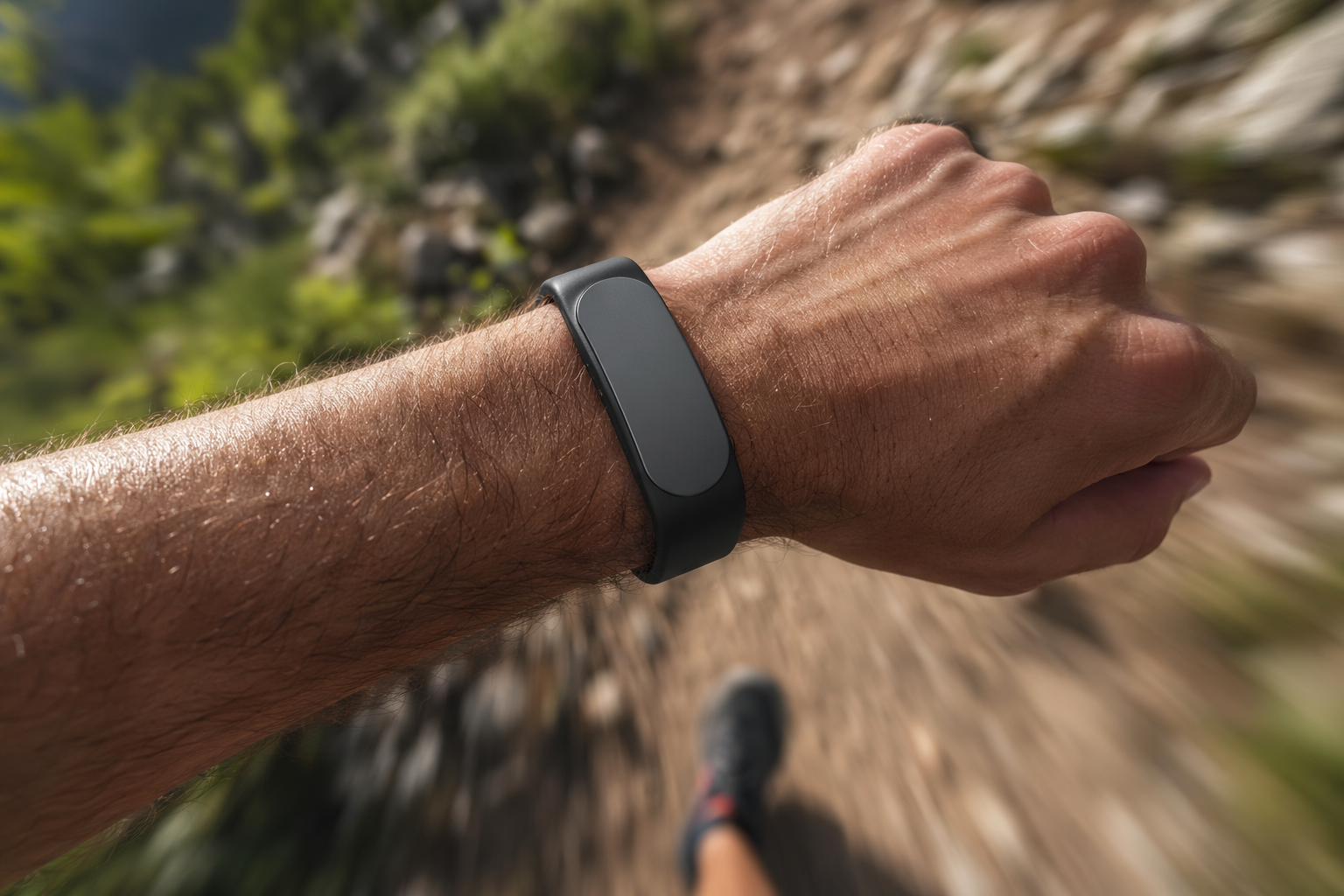
You lace up at 5:30am, slip out the door, and head out alone. No running partner, no support crew, just you and the road. If something goes wrong out there — a cardiac event, a bad fall, a car that doesn't stop — the first stranger who reaches you knows nothing about you. Not your name, not your emergency contact, not whether you're on blood thinners or carry an EpiPen. A runner ID solves that gap. This guide covers what to wear, what information to include, and why waiting until you "need" it is the wrong approach.
Why your race bib isn't enough (the solo training gap)
Race bibs are designed for one purpose: to identify you at timing mats and in finish-line photos. They have your name and race number — sometimes a city, sometimes an age group. What they don't have is the information a paramedic needs in the first 60 seconds of a medical emergency.
More critically: a race bib only exists on race day. The vast majority of your running happens during solo training — early mornings, lunch breaks, evening loops through the neighbourhood. That's when your exposure is highest and your safety net is thinnest. No race marshal, no water station volunteers, no nearby medical tent. Just you, the road, and whatever information is physically attached to your body.
- On-course events are survivable precisely because of infrastructure. Medical staff are stationed every few miles. Volunteers radio for help within seconds. The systems work. Solo training has none of that.
- Bib numbers don't help before or after the race either. Pre-race warm-up runs, post-race cool-downs, travel runs in unfamiliar cities — you're wearing kit but no bib, in places where nobody knows you.
- First responders at the scene of an incident cannot look up a bib number. They need information immediately, not after a phone call to a race organiser's office.
The solution is simple: wear something that carries your critical information on every run, not just on race day. A runner ID bracelet, shoe tag, or QR tag that lives on your wrist or laces every time you head out the door.
What first responders need in the first 60 seconds
When a paramedic or bystander reaches an incapacitated runner, they are working blind. There is no running partner to provide context, no wallet in a pocket (running shorts rarely have real pockets), often no phone accessible. The information they need to treat you effectively is specific and time-sensitive:
- Full name and date of birth — to pull existing records, initiate next-of-kin notification, and manage hospital admission.
- Emergency contact: name and phone number — the person who knows your health history and can make decisions if you cannot.
- Critical medical conditions — a cardiac condition, diabetes, epilepsy, severe allergies. Each changes the treatment protocol significantly. A paramedic administering standard care to an undiagnosed diabetic in hypoglycaemic shock is working with dangerous incomplete information.
- Current medications — especially anticoagulants (warfarin, apixaban, rivaroxaban), which dramatically affect bleeding risk. A runner on blood thinners who takes a hard fall has very different injury management needs.
- Blood type — useful in trauma situations, particularly where rapid fluid management decisions are made.
- Known drug allergies — particularly penicillin, sulfa antibiotics, aspirin, and NSAIDs, which appear in standard emergency protocols. An allergic reaction on top of a trauma event compounds everything.
Most runners have a clean bill of health and the above list will be short. That doesn't mean skipping the ID — it means the ID is fast to set up and easy to carry. The runner who is "perfectly healthy" is exactly who benefits most from having ID, because nothing on it will complicate treatment. And the runner who does have a condition needs it even more.
Runner ID options compared: wristband, shoe tag, necklace, QR
There is no single right answer — the best runner ID is the one you actually wear consistently. Here is an honest comparison of the main options:
- Engraved wristband (Road iD style): The original runner ID format. A silicone or metal band with your name, emergency contact, and key medical conditions engraved directly on it. Requires zero technology to read, stays on your wrist in any weather, survives any fall. The limitation: engraved info is static. If your medications change, you need a new band. Information capacity is limited to a few short lines.
- Dog-tag necklace: Engraved metal tag worn on a breakaway cord. Traditional military-style format with good information density for engraved text. Works well for runners who prefer nothing on their wrists. The breakaway feature prevents injury in a fall; the limitation is that it can flip inward and be less immediately visible.
- Shoe tag / lace tag: A tag or laminated card attached to laces or placed inside the shoe tongue. Useful as a backup layer or for minimal-kit runners who prefer nothing on their body. The limitation is visibility — a first responder may not think to check the shoes. Best used as a second layer, not the only layer.
- QR wristband or tag: A silicone band or attached tag with a QR code that links to a full digital profile. Scannable by any phone camera in under 5 seconds, no app required. Holds unlimited information — full medical history, multiple emergency contacts, allergies, medications, blood type — and updates instantly when your profile changes. Free options like Tagback cost nothing to set up and nothing to maintain.
The strongest setup combines two layers: an engraved ID with your most critical info (name, emergency number, blood type) on the wristband itself, plus a QR tag for the complete medical profile. The engraved tag is readable without any technology if a phone is unavailable; the QR tag holds everything else.
What to include on your runner ID
For an engraved physical ID with limited space, prioritise in this order:
- Full name
- Emergency contact name and mobile number
- Blood type
- Most critical medical condition (one line — e.g. "Type 1 Diabetic" or "Penicillin allergy")
For a QR-linked digital profile — where you have unlimited space — include the full picture:
- Full name, date of birth, home address
- Emergency contact — primary and secondary, with relationship noted
- All current medications — name, dose, frequency
- All known allergies — medications, foods, environmental
- Medical conditions — diagnosed conditions, implanted devices (pacemaker, insulin pump), recent surgeries
- Blood type and Rh factor
- Insurance information — optional but useful for faster hospital processing
- Doctor or specialist contact — particularly if you have a cardiac or neurological condition
One practical note: keep your profile current. A QR ID that shows an outdated medication list is worse than no medication list — it can mislead treatment. The advantage of a QR profile over an engraved tag is that you can update it from your phone in under two minutes. Do so whenever anything changes.
Trail running: higher stakes, same principles
Everything that applies to road running applies to trail running, with the intensity turned up significantly. When you are three miles from the trailhead on a technical singletrack, the response time for any emergency is measured in tens of minutes, not seconds. Cell coverage may not exist. Other trail users may be sparse.
- Remote location compounds everything. On a road, someone calls 911 and a unit arrives in minutes. On a trail, the first person who finds you may be another trail runner who has to run back out to get signal before help can be dispatched. Every piece of information you can provide on your body reduces the confusion in that window.
- Ankle rolls, knee impacts, and head injuries are more likely off-road. A trail runner with an ankle fracture may be incapacitated far from a road. A QR tag on the vest strap or pack hipbelt gives any trail user who finds you immediate access to who to call and what conditions to know about.
- Vest and pack placement: Trail runners wearing a running vest should put a QR tag on the front chest strap or shoulder strap — the most visible position when someone is kneeling over you. Not tucked in a pocket. Not on the back.
- The trail plan layer: A QR profile that includes your intended route, expected return time, and parking location gives responding trail users and search and rescue teams information no medical bracelet can carry. "Out-and-back on the ridge trail, back by noon, parked at east trailhead" costs nothing to add and can significantly reduce search time.
- Race bibs at organised trail events: A QR sticker on the back of your bib at an ultra or organised trail event means race marshals, aid station volunteers, and other competitors can scan you if you're found in difficulty on course. Many race organisations now recommend or require this.
Trail running is statistically very safe. Serious incidents are uncommon relative to the millions of hours logged on trails every year. The ID setup described here adds nothing to your pack weight and takes one afternoon to configure. It is the definition of a free, lightweight, permanent upgrade.
Setting up your runner QR ID (the 5-minute setup)
"I'm fit and healthy — I don't need medical ID" is the most common reason runners skip this step. It is also the most dangerous myth in runner safety. Sudden cardiac arrest accounts for a significant portion of on-course deaths in marathons, and it disproportionately affects fit, apparently healthy athletes. The mechanism — typically a previously undetected structural heart abnormality or an arrhythmia — is not visible in training. Hypertrophic cardiomyopathy, the most common cause of sudden cardiac death in young athletes, often produces no symptoms until collapse.
Carrying ID is not an admission that something is wrong. It is the standard practice of any serious runner who understands that first responders cannot help you effectively if they know nothing about you.
Here is the full setup, start to finish:
- Set up your phone Medical ID first. iPhone: Health app → Medical ID → enable "Show When Locked." Android: Settings → Safety & Emergency → Emergency Information. This takes 3 minutes and is free. A first responder can access it from the emergency call screen without unlocking your phone.
- Create a Tagback QR profile. Go to tagback.org, create a free account, and set up a Person tag. Fill in the medical fields — name, emergency contacts, conditions, medications, allergies, blood type. The form takes about 5 minutes. There is no subscription, no limit on the information you can enter, and no paid tier. It is completely free.
- Attach the QR tag to what you always wear. Print the QR code and laminate it, or use a silicone QR wristband, or attach a tag to your vest strap or laces. The specific format matters less than the rule: it should be on your body every time you run, not something you remember on some runs.
- Test it. Scan with a second phone and walk through the finder card. Make sure the information is accurate, the emergency contact works, and the profile loads cleanly. Do this before your next run.
- Tell your emergency contact. Make sure the person listed on your tag knows they're listed and knows what Tagback is. A 30-second conversation now means they'll respond faster in an emergency.
The ID that takes 5 minutes to set up stays useful for years. Update the profile whenever your medications or emergency contacts change — it takes two minutes from your phone and the QR code on your wristband never needs to be replaced.
FAQ
Does Road iD work the same as a Tagback QR tag?+
Different approaches. Road iD is an engraved physical tag with your static info — reliable and low-tech. A QR runner ID (like Tagback) holds unlimited info that you can update anytime, including medications, allergies, and emergency contacts — and it's free. The ideal setup is engraved basics (name, emergency number) on the wristband plus a QR tag for the extended medical profile.
Can I put a QR tag on my running shoe?+
Yes. Lace tags and insole tags work well and are designed for exactly this. Silicone QR tags are flexible, sweat-resistant, and designed to attach to laces. Make sure the QR code is on the outside, not tucked under the shoe.
Is a runner ID only for people with medical conditions?+
No. Even healthy, fit people should carry ID. Sudden cardiac arrest can happen to athletes in peak condition — it accounts for a significant portion of on-course deaths in marathons. Your ID lets first responders treat you faster and contact your family immediately, regardless of your health status.
What if I forget to wear my runner ID?+
Before solo runs, text or share your route with someone who knows your expected return time. Enable emergency SOS on your phone. Some runners use the emergency contact feature on their smartwatch. These backups aren't as good as wearing ID, but they're better than nothing.
Start protecting what matters
Tagback is free, forever. No subscription. No app needed for finders.
Create your free tag