
A Discreet QR on a Dementia Patient's Jacket
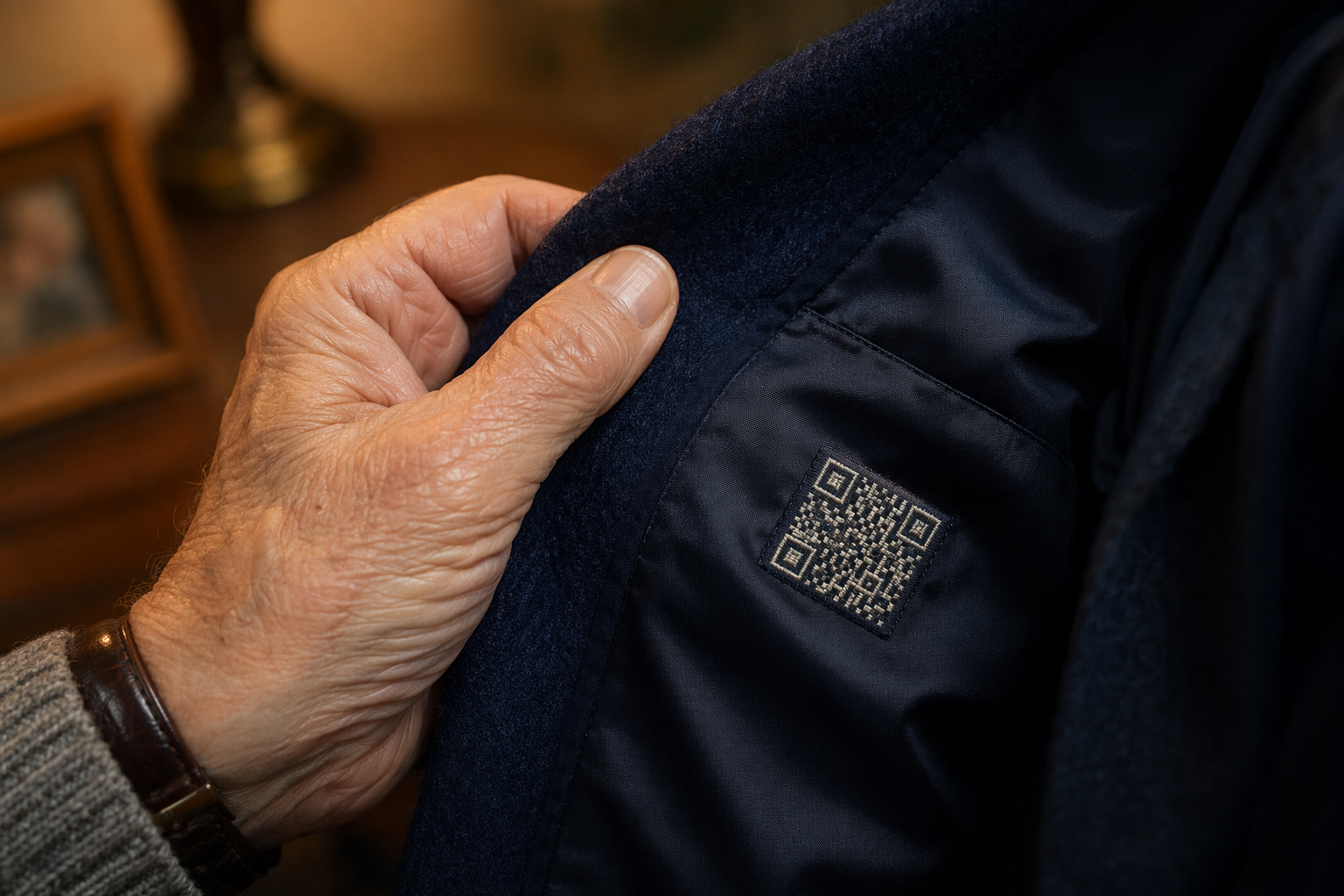
6 in 10 people with dementia wander at least once. Visible medical-alert jewelry feels stigmatizing — most patients refuse to wear it. A QR embroidered inside the lining of a jacket they wear daily is the most-recommended quiet safety measure in caregiver communities.
Why this approach works
- Invisible until needed — embroidered inside the lining or under a placket, not visible during normal wear.
- Can't be removed — it's part of the garment.
- Patient doesn't feel labelled — no "medical alert" visible badge.
- Survives the wash — polyester thread outlasts the jacket.
- Auto-translates — if your parent wanders into a Spanish-speaking neighborhood, the finder card opens in Spanish for the scanner.
Where to embroider
| Location | Pros | Cons |
|---|---|---|
| Inside the chest panel (lining) | Most accessible when jacket is unzipped | Need to access lining for stitching |
| Inside collar (back) | First place EMTs look for ID | Small area, may need to scale down QR |
| Inner cuff | Easy to find without unbuttoning | Smaller area; rub against wrist |
| Hem inside the front pocket | Hidden but easy to scan | Less obvious to a stranger |
| Sewn-in fabric patch | Versatile — move to any jacket | Slight risk of patch detaching |
Best practice for most caregivers: a 6×6 cm patch embroidered separately, then hand-sewn into the inside chest of the daily jacket. If the patient swaps jackets seasonally, you can transfer the patch to the new one in 5 minutes.
What to write near the QR
Pair the embroidered QR with small text below, also embroidered:
- "IF FOUND, SCAN — PLEASE CALL FAMILY" — plain, kind, no medical disclosure
- Optional language: "GENTLY APPROACH" — guides bystanders' behaviour
- Avoid: "DEMENTIA PATIENT," "ALZHEIMER'S," specific diagnoses. The Tagback contact card handles medical info privately once scanned.
The whole point is the visible patch only triggers the scan. The actual medical info, contacts, and instructions live behind the QR scan in the Tagback dashboard, where you control what the finder sees.
What lives in the Tagback dashboard
On the contact card you can set, in order of priority:
- First name and photo — finder confirms identity
- One-line instruction: "Has dementia. Please call my daughter — number below — before involving emergency services."
- Call trusted contact button — your number, masked by Tagback relay
- Backup contact — partner, sibling, neighbour (in case primary is unreachable)
- Address / neighbourhood — your local area, not the full home address
- Calming techniques — what helps if patient becomes agitated
Step-by-step: making a sew-on patch
Materials
- Felt or canvas square, ~70×70 mm, in jacket-matching color
- Heavy cut-away stabilizer, same size
- Polyester embroidery thread, one color (high contrast against the felt)
- Tagback DST or PES from your dashboard
- Iron-on backing OR hand-sewing supplies
Steps
- Hoop the felt + stabilizer in your 80×80 mm hoop.
- Load DST/PES, set thread color, stitch (8–12 min on home machines).
- Trim the felt to ~50×50 mm square around the embroidery, leaving 5mm border.
- Iron-on option: apply iron-on adhesive to the back, press onto the jacket lining following the iron-on instructions.
- Hand-sew option (recommended for longevity): use a simple straight stitch around the edge in matching thread.
Other items to embroider for one patient
- Daily wallet card — embroidered patch on a card holder, second chance for a finder who finds the wallet first
- Slippers / shoes — if patient wanders without a jacket
- Cane handle wrap — discreet, always with them
- Phone case fabric inset — paramedics often look at the phone first
- Inside the favorite watch band — for patients who refuse to remove a watch
What if the patient resists the jacket?
Embroider on the lining of the jacket they're wearing now. They never see it. Don't tell them — there's no medical advantage to disclosure, and many caregivers we've talked to say the patient becomes anxious if they realize they're 'being tracked.'
If the patient changes jackets seasonally, embroider the patch separately and move it. 5 minutes of hand-sewing per swap.
Multi-layer approach (recommended)
Caregiver communities consistently recommend layering multiple identification methods:
- Embroidered jacket QR — primary, invisible-until-scanned
- Wallet card with QR — second chance
- Medical alert bracelet — for EMTs who look there first
- Phone tracking (Apple Watch SOS, Galaxy Watch, AngelSense) — for live location
Each layer addresses a different scenario. The QR is the strongest middle layer — it bridges the gap between "a stranger found them" and "emergency services involved."
FAQ
Will the patient feel labelled?+
No — embroidery inside the lining isn't visible during normal wear. Even if they see it, the text is intentionally vague ("please call family"), not medical. The diagnosis lives only behind the QR scan.
What if the finder doesn't know to scan?+
Add a small embroidered text near the QR: "IF FOUND PLEASE SCAN." Most modern phones recognize QR codes automatically when the camera is pointed at them. Tagback also opens the contact card in the finder's phone language automatically.
Can I hand-embroider it?+
Technically yes but practically no — hand-embroidery at the density required for a scannable QR would take many hours and risks irregular stitches that fail the scan. Use an embroidery machine or contact a local embroidery shop ($10–20 per item).
What does the finder see when they scan?+
Whatever you've configured in your Tagback dashboard. The default for a Person tag is: first name, photo, "contact family" button, and optional medical info that unlocks when a finder presses "Emergency." You control privacy levels.
Is the embroidery washable on a regular cycle?+
Yes — polyester thread survives cold/warm washes indefinitely. Hot water and aggressive drying will eventually fade the contrast slightly. Most caregivers wash on cold and air-dry the embroidered jacket.
Start protecting what matters
Tagback is free, forever. No subscription. No app needed for finders.
Create your free tag